Product Description
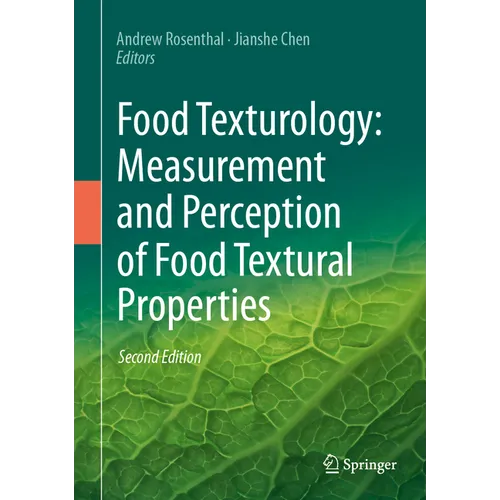
by Andrew Rosenthal (Editor), Jianshe Chen (Editor)
The concept behind this book is to take a holistic view of food texture, starting with the determination of food texture, its perception in the mouth, and its measurement by both sensory and instrumental methods, and to examine the relation between them. The book has been divided into four sections: Fundamentals, Sensory and Human Interactions, Instrumental Analysis, and Food Products. Essentially we cover the techniques used for measuring food texture, and then apply them to the different product groups.
Readers of the first edition will notice the title has changed, with the adoption of the term texturology. In the long history of food texture research, texturology has been occasionally used in literature. The term texturology has not been widely accepted by texture researchers (texturologists) because of their concern over whether the theories and techniques are broad and strong enough to support texture research as a scientific discipline. During the 24 years since the publication of the first edition, the editors have observed vast developments in theories as well as the assessment methodology of food texture (both sensory and instrumental) and these have shaped our understanding. This second edition brings the science up to date by introducing topics not previously covered (e.g. psychophysics, tribology, oral processing, texture maps and special foods for dysphagia patients). It includes an exposé of the instruments to measure food texture, and also considers techniques for measuring consumer perception of food texture (in addition to the sensory properties). Additionally, it amends omissions from the first edition such as dairy products; fish; bakery products; and, sugar confectionery, asproduct groups. All in all it is expanded and updated in its coverage of food texturology, as a coherent scientific discipline.
Back Jacket
The concept behind this book is to take a holistic view of food texture, starting with the determination of food texture, its perception in the mouth, and its measurement by both sensory and instrumental methods, and to examine the relation between them. The book has been divided into four sections: Fundamentals, Sensory and Human Interactions, Instrumental Analysis, and Food Products. Essentially we cover the techniques used for measuring food texture, and then apply them to the different product groups.
Readers of the first edition will notice the title has changed, with the adoption of the term texturology. In the long history of food texture research, texturology has been occasionally used in literature. The term texturology has not been widely accepted by texture researchers (texturologists) because of their concern over whether the theories and techniques are broad and strong enough to support texture research as a scientific discipline. During the 24 years since the publication of the first edition, the editors have observed vast developments in theories as well as the assessment methodology of food texture (both sensory and instrumental) and these have shaped our understanding. This second edition brings the science up to date by introducing topics not previously covered (e.g. psychophysics, tribology, oral processing, texture maps and special foods for dysphagia patients). It includes an exposé of the instruments to measure food texture, and also considers techniques for measuring consumer perception of food texture (in addition to the sensory properties). Additionally, it amends omissions from the first edition such as dairy products; fish; bakery products; and, sugar confectionery, asproduct groups. All in all it is expanded and updated in its coverage of food texturology, as a coherent scientific discipline.
Author Biography
Andrew Rosenthal's research interests are centred on food texture and its measurement. He has published widely with around forty research articles, as well as four books. Before the pandemic, Andrew was an Associate Professor in Food Science at the University of Nottingham, though now he has retired and lives in Baiersbronn, Germany, with his wife Sheila and four dogs.
Jianshe Chen is a specially appointed professor at Zhejiang Gongshang University, Hangzhou, China. During his early years at the University of Leeds, UK, Prof. Chen pioneered research in food oral processing. His current study focuses on the fundamental principles of eating and sensory perception by applying a combined approach involving food physics, oral physiology and sensory psychology. Prof. Chen has published four books and authored nearly 200 research papers.