Skip to content
Welcome To Our Store.
100,000+ Products for Home, Medical, Office & Classroom Needs
Search
Skip to product information
1 of 1

Financial Economics: A Simple Introduction - Paperback

$16.52 USD
$16.52 USD
Sale Sold out
Shipping calculated at checkout.
In stock (100 units), ready to be shipped

Available Offers

Fastest Delivery Tomorrow With Vip DealOrder within 1 hr 8 mins.

Instant 10% Discount On HDFC Banks Credit/Debit Cards EMI and CreditCard

Secure checkout with
  • American Express
  • Apple Pay
  • Diners Club
  • Discover
  • Google Pay
  • Mastercard
  • PayPal
  • Shop Pay
  • Visa

Flight Range: Up to 1,000 meters (3,280 feet)

Maximum Speed: 45 kilometers per hour (28 miles per hour)

For all orders exceeding a value of 100USD shipping is offered for free.

Returns will be accepted for up to 10 days of Customer’s receipt or tracking number on unworn items. You, as a Customer, are obliged to inform us via email before you return the item.

Otherwise, standard shipping charges apply. Check out our delivery Terms & Conditions for more details.

View Product Details
Shopping cart
Product Product subtotal Quantity Price Product subtotal
Financial Economics: A Simple Introduction - Paperback
$16.52/ea
$0.00
$16.52/ea $0.00

Product Description

by K. H. Erickson (Author)

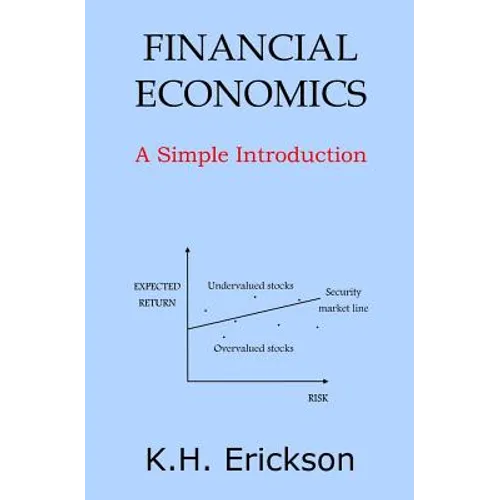
Financial Economics: A Simple Introduction offers an accessible guide to the central ideas and methods of financial economics, with examples and calculations, empirical evidence, and over 20 diagrams to support the analysis.


Understand consumption and investment decisions, intertemporal choice, indifference curves and the marginal rate of substitution, production possibilities and the marginal rate of transformation, rates of return, the financial market line, borrowing and lending, and the Fisher Separation Theorem.


Portfolio theory examines expected returns, standard deviation and variance risk, covariance, correlation, asset diversification, market portfolio, a risk-free asset, the capital market line, and the Tobin Separation Theorem.


The capital asset pricing model (CAPM) explores diversifiable and non-diversifiable risk, the beta risk factor, calculation of an asset's expected return, the security market line, asset evaluation, and empirical evidence on the CAPM.


Market efficiency looks at the efficient market hypothesis (EMH), weak, semi-strong, and strong form efficiency, and the literature on technical and fundamental analysis strategies to beat the market.

Number of Pages: 102
Dimensions: 0.21 x 8 x 5.25 IN
Publication Date: January 21, 2014
you might like