


Product Description
by Munk (Author)
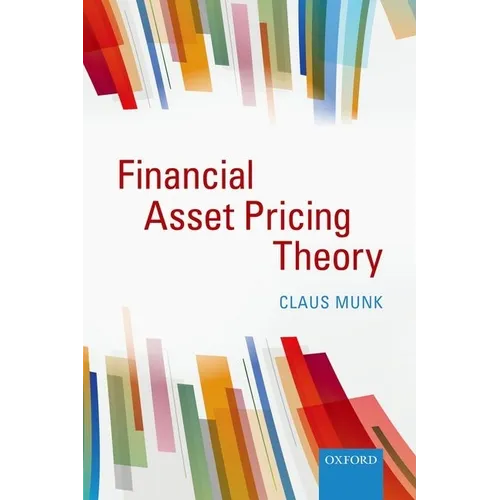
Financial Asset Pricing Theory offers a comprehensive overview of the classic and the current research in theoretical asset pricing. Asset pricing is developed around the concept of a state-price deflator which relates the price of any asset to its future (risky) dividends and thus incorporates how to adjust for both time and risk in asset valuation. The willingness of any utility-maximizing investor to shift consumption over time defines a state-price deflator which provides a link between optimal consumption and asset prices that leads to the Consumption-based Capital Asset Pricing Model (CCAPM). A simple version of the CCAPM cannot explain various stylized asset pricing facts, but these asset pricing 'puzzles' can be resolved by a number of recent extensions involving habit formation, recursive utility, multiple consumption goods, and long-run consumption risks. Other valuation techniques and modelling approaches (such as factor models, term structure models, risk-neutral valuation, and option pricing models) are explained and related to state-price deflators.
The book will serve as a textbook for an advanced course in theoretical financial economics in a PhD or a quantitative Master of Science program. It will also be a useful reference book for researchers and finance professionals. The presentation in the book balances formal mathematical modelling and economic intuition and understanding. Both discrete-time and continuous-time models are covered. The necessary concepts and techniques concerning stochastic processes are carefully explained in a separate chapter so that only limited previous exposure to dynamic finance models is required.Author Biography
Claus Munk, Professor of Finance, Copenhagen Business School
Claus Munk holds a PhD in Economics (1997) and an MSc in Mathematics-Economics (1993) from the University of Southern Denmark. After holding positions at the University of Southern Denmark and Aarhus University, he joined the Copenhagen Business School in 2012 as a Professor of finance. His primary research areas are asset allocation, general asset pricing theory, financial derivatives, household finance, executive compensation, and the application of numerical methods in finance. His research has been published in highly ranked journals such as Journal of Financial Economics, Management Science, Journal of Accounting Research, Journal of Banking and Finance, and Journal of Economic Dynamics and Control. He is the author of the books Fixed Income Modelling and Financial Asset Pricing Theory, both published by Oxford University Press.