Product Description
by Jeremy D. Yunt (Author)
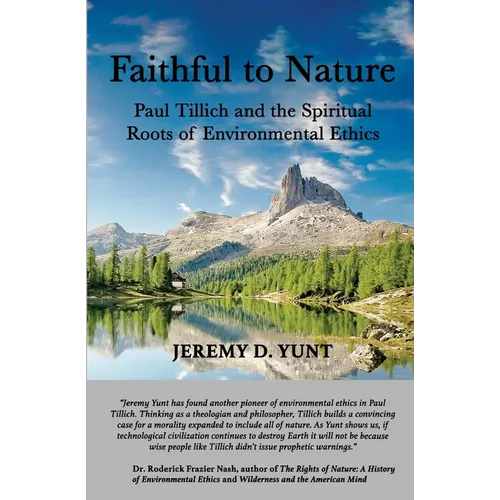
Paul Tillich (1886-1965) is generally considered the most original and influential theologian of the 20th century. What's not as widely recognized, outside of academic circles, is his stature as a first-rate existentialist philosopher-in the lineage of Kierkegaard, Heidegger, Nietzsche, and Pascal. Few people have analyzed more areas of existence: from art and architecture to culture, science, economics, politics, technology, psychology, world religions (particularly Buddhism), history, and health and healing. But one of Tillich's primary and enduring concerns was humanity's troubled relationship with the natural world. It was his belief that empathizing with and defending nature was of vital importance to the human spirit, bringing great depth and meaning to our experience of life itself. Though the 1962 publication of Rachel Carson's Silent Spring is seen as a pivotal moment in awakening the environmental movement, Tillich was writing decades before this of the commodification and desecration of the natural world. He witnessed the rise of industrialization and the power of this synthetic world to bend humanity to its demands, and warned that "we are living in the late stage of the self-destruction of industrial society, as a world above the given world of nature." Though creative in many respects, he also saw this technical enterprise impoverishing our spiritual lives and inflicting untold suffering on a defenseless planet and our fellow nonhuman animals. With great implications for environmental ethics, a central part of Tillich's theology is his "multidimensional unity of life," a unique scientific and moral perspective that vastly expands our concept of life, granting deep significance to even the inorganic dimension. Perhaps most importantly, Tillich challenges religious views that see life on this planet as subordinate to the "real" lives to come after death, famously stating that "there is no salvation salvus: to heal and make whole] of man if there is no salvation of nature, for man is in nature and nature is in man." In this timely and original assessment of Tillich, Yunt provides a philosophical bulwark against the modern world's increasing assault on science, reason, and nature. And by examining contemporary environmental movements such as deep ecology and ecopsychology, as well as current issues like climate change and the impact of human diet and new technologies on the planet, Yunt brings clarity to the increasingly obvious fact that humans are within the realm of the natural world, not above it.
Author Biography
Jeremy D. Yunt is a writer and independent scholar who holds a bachelor's degree in Environmental Studies from the University of California at Santa Cruz, and an interdisciplinary master's degree in Ethics (Philosophy) and Depth Psychology from the Graduate Theological Union, Berkeley, California. While in graduate school, he worked as a writer and editor for The Center for Theology and the Natural Sciences (CTNS) on a special program on religion, science, and environmental ethics. Prior to that, he worked as a writer and editor for the Sierra Club Legal Defense Fund, in San Francisco. Mr. Yunt also contributed to the multi-award winning book "Life on the Edge: A Guide to California's Endangered Natural Resources" (Heyday Press, 1994). He's published peer-reviewed articles in "Philosophy Now" (UK) and "The Journal of Humanistic Psychology," among others.