Product Description
by A. J. Underwood (Author)
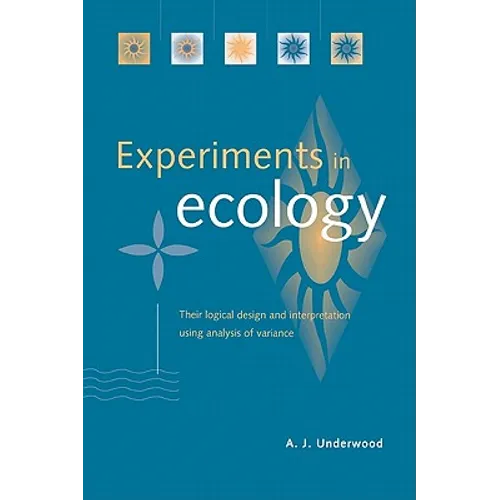
Ecological theories and hypotheses are usually complex because of natural variability in space and time, which often makes the design of experiments difficult. This book describes how to design ecological experiments from a statistical basis using analysis of variance, so reliable conclusions can be drawn. The logical procedures that lead to a need for experiments are described, followed by an introduction to simple statistical tests. This leads to a detailed account of analysis of variance, looking at procedures, assumptions, and problems. One-factor analysis is extended to nested (hierarchical) designs and factorial analysis. Finally, some regression methods for examining relationships between variables are covered. Examples of ecological experiments are used throughout to illustrate the procedures and examine problems. This book will be invaluable to practicing ecologists as well as advanced students involved in experimental design.
Back Jacket
Ecological theories and hypotheses are usually complex because of natural variability in space and time, which often makes the design of experiments difficult. The statistical tests we use require data to be collected carefully and with proper regard to the needs of these tests. This book describes how to design ecological experiments from a statistical basis using analysis of variance so that we can draw reliable conclusions. The logical procedures that lead to a need for experiments are described, followed by an introduction to simple statistical tests. This leads to a detailed account of analysis of variance, looking at procedures, assumptions and problems. One-factor analysis is extended to nested (hierarchical) designs and factorial analysis. Finally, some regression methods for examining relationships between variables are covered. Examples of ecological experiments are used throughout to illustrate the procedures and examine problems. This book will be invaluable to practising ecologists in addition to advanced students involved in experimental design.