Product Description
by Jessica F. Green (Author)
A new way to tackle the real politics of climate change through asset revaluation
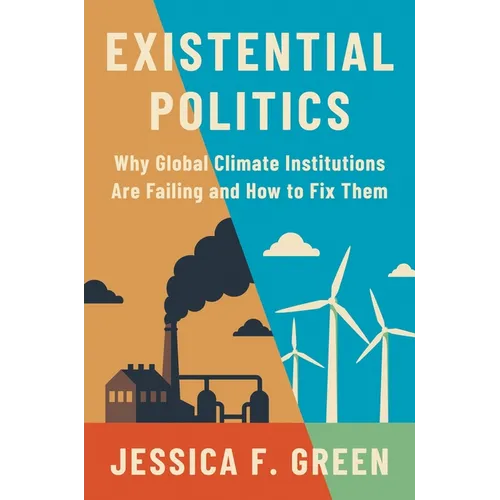
It's no secret that the Paris Agreement and voluntary efforts to address climate change are failing. Governments have spent three decades crafting international rules to manage the climate crisis yet have made little progress on decarbonization. In Existential Politics, Jessica Green explains why this is unsurprising: governments have misdiagnosed the political problem of climate change, focusing relentlessly on measuring, reporting, and trading emissions. This technical approach of "managing tons" ignores the ways that climate change and climate policy will revalue assets, creating winners and losers. Policies such as net zero, carbon pricing, and offsets all cater to the losers--owners of fossil assets. Ultimately, Green contends, climate change is a political problem. Climate politics should be understood as existential--creating conflicts that arise when some actors face the prospect of the devaluation or elimination of their assets or competition from the creation of new ones. Fossil asset owners, such as oil and gas companies and electric utilities, stand to lose trillions in the energy transition. Thus, they are fighting to slow decarbonization and preserve the value of their assets. Green asset owners, who will be the basis of the decarbonized economy, are fewer in number and relatively weak politically. Green proposes using international tax, finance, and trade institutions to create new green asset owners and constrain fossil asset owners, reducing their clout. Domestic investments in green assets, facilitated by global trade rules, can build the political power of green asset owners.Author Biography
Jessica F. Green is Professor in the Department of Political Science and in the School of the Environment at the University of Toronto.
Number of Pages: 224
Dimensions: 0.51 x 9.21 x 6.14 IN
Publication Date: October 07, 2025