


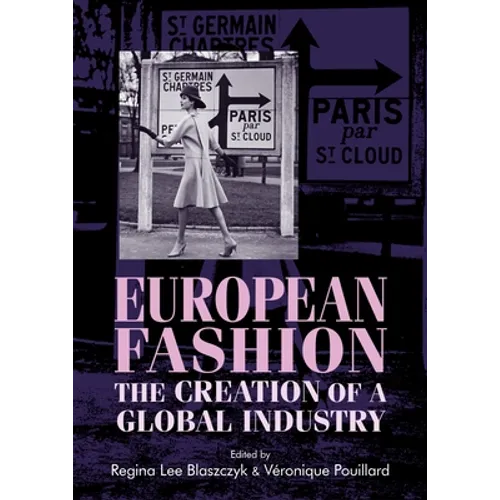
Product Description
by Regina Lee Blaszczyk (Editor), Véronique Pouillard (Editor)
The period since 1945 has been a transformative era for the fashion industry. Over the course of seventy years, the fashion world has moved from celebrating the craftsmanship of haute couture to revelling in ever-changing fast-fashion. This volume examines the transition from the old system to the new in a series of case studies grouped around three major themes. Part I focuses on Paris as a creative hub, aiming to understand how the birthplace of haute couture adapted to late-twentieth-century developments. Part II considers the retailer's role in shaping taste, responding to consumer expectations and disseminating fashion merchandise. Part III looks to alternative visions of the European fashion system that have appeared in unexpected places. The volume is highly interdisciplinary, covering design history, cultural anthropology, ethnography, management studies and the cultural history of business.
Front Jacket
'This book does a superb job of showing European fashion as a creative industry that connects design, purchasing and retail on a global scale. It puts fashion at the centre of a new understanding of innovation processes at large.' Patrick Fridenson, Professor of International Business History, École des Hautes Études en Sciences Sociales, Paris This volume embodies a new approach to the study of fashion history. Highly interdisciplinary, it is informed by design history, cultural anthropology, ethnography, management studies on creativity and the new cultural history of business. It shifts the debate on fashion to the internal culture of the trade, moving beyond the idea of the designer as a lone creative genius and examining the contributions of other figures: trendsetters, retail buyers, stylists, art directors, merchandise managers, brand managers and entrepreneurs. These intermediaries - Giovanni Battista Giorgini, Maurice Rentner, Jean d'Allens and Erling Persson, among others - may be lesser-known outside the industry, but they represent a constellation of important actors characterised by a cosmopolitan outlook, an openness to new modes of operation and the recognition that women have something to say about fashion, not simply as consumers, but as trend forecasters and executives. The postwar world saw the decline of the old hierarchical fashion system, leading one prominent American journalist to declare 'the end of fashion'. This volume argues that, on the contrary, the resulting shakeup created an ever-powerful and increasingly global fashion industry, as the hegemony of Paris and prescriptive modes of dress were replaced by an international network of trendsetters and 'fashion for everyone'. Distinguished contributors include Regina Lee Blaszczyk (University of Leeds), Véronique Pouillard (University of Oslo), Sonnet Stanfill (Victoria & Albert Museum) and Barbara Townley (Saint Andrews). Preface by Geoffrey Jones (Harvard Business School).
Back Jacket
'This book does a superb job of showing European fashion as a creative industry that connects design, purchasing and retail on a global scale. It puts fashion at the centre of a new understanding of innovation processes at large.'
Patrick Fridenson, Professor of International Business History, École des Hautes Études en Sciences Sociales, Paris
Author Biography
Regina Lee Blaszczyk is Leadership Chair in the History of Business and Society, and Professor of Business History at the University of Leeds
Véronique Pouillard is Associate Professor in the History of Modern Europe at the Institute for Archaeology, Conservation, and History (IAKH) at the University of Oslo


