Product Description
by David Z. Moster (Author)
Chapter 1 - IntroductionChapter 2 - Journey from China to IsraelChapter 3 - The Many Interpretations of Peri 'eṣ Hadar (Leviticus 23:40) Chapter 4 - From Foreign Import to Jewish SymbolChapter 5 - ConclusionChapter 6 -Addendum: Hala Sultan Tekke and Karnak
Back Jacket
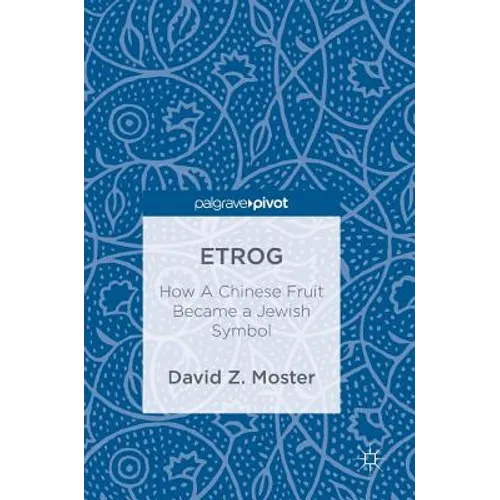
Every year before the holiday of Sukkot, Jews all around the world purchase an etrog--a lemon-like fruit--to participate in the holiday ritual. In this book, David Z. Moster tracks the etrog from its evolutionary home in Yunnan, China, to the lands of India, Iran, and finally Israel, where it became integral to the Jewish celebration of Sukkot during the Second Temple period. Moster explains what Sukkot was like before and after the arrival of the etrog, and why the etrog's identification as the "choice tree fruit" of Leviticus 23:40 was by no means predetermined. He also demonstrates that once the fruit became associated with the holiday of Sukkot, it began to appear everywhere in Jewish art during the Roman and Byzantine periods, and eventually became a symbol for all the fruits of the land, and perhaps even the Jewish people as a whole.
Author Biography
David Z. Moster is the Director of the Institute of Biblical Culture (BiblicalCulture.org), a live online community with classes taught by professors from both Jewish and Christian backgrounds. He is also a fellow in the department of Jewish Studies at Brooklyn College. David received his PhD in Hebrew Bible from Bar-Ilan University in Israel. Before attending Bar-Ilan, David spent two years studying in Israel and holds M.S. and Rabbinical Degrees (semikah) from Yeshiva University, as well as an M.A. in Hebrew Bible from New York University.