


Product Description
by Gi-Wook Shin (Author)
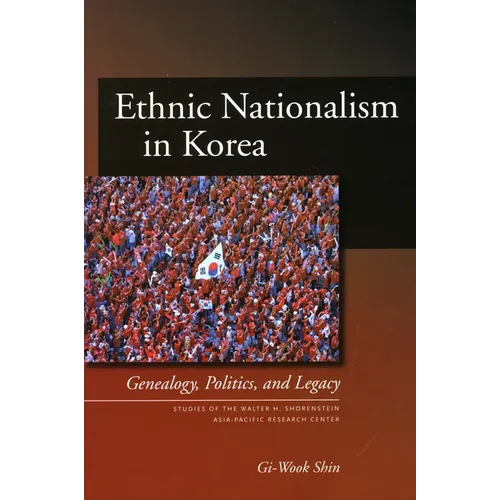
This book is the first comprehensive treatment of the roots, politics, and legacy of Korean ethnic nationalism from a sociohistorical perspective.
Front Jacket
This book explains the roots, politics, and legacy of Korean ethnic nationalism, which is based on the sense of a shared bloodline and ancestry. Belief in a racially distinct and ethnically homogeneous nation is widely shared on both sides of the Korean peninsula, although some scholars believe it is a myth with little historical basis. Finding both positions problematic and treating identity formation as a social and historical construct that has crucial behavioral consequences, this book examines how such a blood-based notion has become a dominant source of Korean identity, overriding other forms of identity in the modern era. It also looks at how the politics of national identity have played out in various contexts in Korea: semicolonialism, civil war, authoritarian politics, democratization, territorial division, and globalization.
Back Jacket
This book explains the roots, politics, and legacy of Korean ethnic nationalism, which is based on the sense of a shared bloodline and ancestry. Belief in a racially distinct and ethnically homogeneous nation is widely shared on both sides of the Korean peninsula, although some scholars believe it is a myth with little historical basis. Finding both positions problematic and treating identity formation as a social and historical construct that has crucial behavioral consequences, this book examines how such a blood-based notion has become a dominant source of Korean identity, overriding other forms of identity in the modern era. It also looks at how the politics of national identity have played out in various contexts in Korea: semicolonialism, civil war, authoritarian politics, democratization, territorial division, and globalization.
Author Biography
Gi-Wook Shin is Director of the Asia-Pacific Research Center, Senior Fellow at the Stanford Institute for International Studies, and Associate Professor of Sociology at Stanford University. He is the author/editor of numerous books and articles including Contentious Kwangju (2004), Colonial Modernity in Korea (1999), and Peasant Protest and Social Change in Colonial Korea (1996).



