


Product Description
by Ruth Linn (Author)
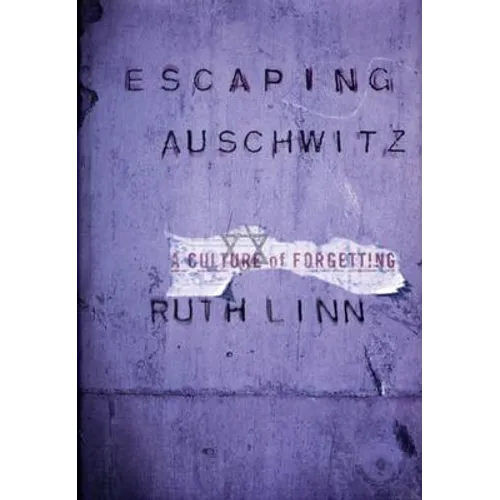
On 7 April 1944 a Slovakian Jew, Rudolf Vrba (born Walter Rosenberg), and a fellow prisoner, Alfred Wetzler, succeeded in escaping from Auschwitz-Birkenau. As block registrars both men had been allowed relative (though always risky) freedom of movement in the camp and thus had been able to observe the massive preparations underway at Birkenau of the entire killing machine for the eradication of Europe's last remaining Jewish community, the 800,000 Jews of Hungary. The two men somehow made their way back to Slovakia where they sought out the Jewish Council (Judenrat) to warn them of the impending disaster. The Vrba-Wetzler report was the first document about the Auschwitz death camp to reach the free world and to be accepted as credible. Its authenticity broke the barrier of skepticism and apathy that had existed up to that point. However, though their critical and alarming assessment was in the hands of Hungarian Jewish leaders by April 28 or early May 1944, it is doubtful that the information it contained reached more than just a small part of the prospective victims--during May and June 1944, about 437,000 Hungarian Jews boarded, in good faith, the "resettlement" trains that were to carry them off to Auschwitz, where most of them were gassed on arrival. Vrba, who emigrated to Canada at war's end, published his autobiography in England nearly forty years ago. Yet his and Wetzler's story has been carefully kept from Israel's Hebrew-reading public and appears nowhere in any of the history texts that are part of the official curriculum. As Ruth Linn writes, "Israeli Holocaust historiography was to follow the spirit of the court's policy at the Eichmann trial: silencing and removing challenging survivors from the gallery, and muting questions about the role of the Jewish Council in the deportations." In 1998 Linn arranged for publication of the first Hebrew edition of Vrba's memoirs. In Escaping Auschwitz she establishes the chronology of Vrba's disappearance not only from Auschwitz but also from the Israeli Holocaust narrative, skillfully exposing how the official Israeli historiography of the Holocaust has sought to suppress the story.
Author Biography
Ruth Linn is Dean of the Faculty of Education at Haifa University, Israel. She is the author of Not Shooting and Not Crying: A Psychological Inquiry into Moral Disobedience (1989), Conscience at War: The Israeli Soldier as a Moral Critic (1996), and Mature Unwed Mothers: Narratives of Moral Resistance (2002).