


Product Description
by Bruce Lenman (Author)
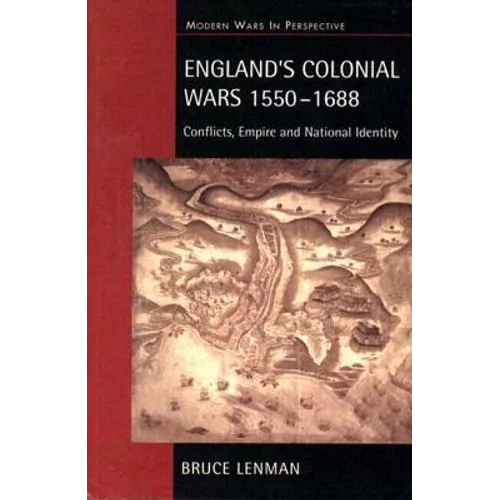
Bruce Lenman's hugely ambitious study explores three interacting themes: the growth of England's sprawling colonial empire; its military dimension; and the impact of colonial warfare on national identity. He starts in Ireland, with the renewed assault of English settlers on the Irish Gaeltacht. Under the (Scottish) Stuarts, England then began a dramatic expansion across the North Atlantic. In America, the 'Indian Wars', fought with minimal Crown support, helped forge an independent military capability among the colonists; while, in the West Indies, slave numbers and French intervention forced English settlers into a new dependency on the Crown. In India, the East India Company achieved ascendancy by sepoy armies under British control. These were very different kinds of empire; and a showdown became inevitable. The climactic conflict, the American Revolution, would not only dictate the future shape of colonial expansion, but also decisively reshaped the identities of all the participants.
Back Jacket
This hugely ambitious study explores the birth of England s sprawling colonial empire from its origins in the middle of the sixteenth century to the Glorious Revolution. The complexity of the military dimensions is explored independently and in relation to the impact of colonial warfare on national identity.
Starting with Ireland and England in the Tudor period, the renewed assault of English settlers on the Irish Gaeltacht is described and analysed. By 1600 this conflict was beyond rational control, leaving the nation fatefully fissured.
Under the (Scottish) Stuarts, England then began a dramatic expansion across the North Atlantic. In America, the Indian Wars, fought with minimal Crown support, helped forge an independent military capability among the colonists; while, in the West Indies, slave numbers and French intervention forced English settlers into a new dependency on the Crown.
In India, the East India Company achieved ascendancy by sepoy armies under British control. England's Colonial Wars shows that these were very different kinds of empire achieved and sustained in divergent ways and with profoundly differing long-term consequences.
Bruce Lenman is Professor of Modern History at the University od St. Andrews. He has also written Britain's Colonial Wars, 1688 - 1783.
Author Biography
Bruce Lenman is Professor of Modern History at the University of St. Andrews. He has also written Britain's Colonial Wars, 1688 - 1783.



