Product Description
by Stephen Snyder (Author)
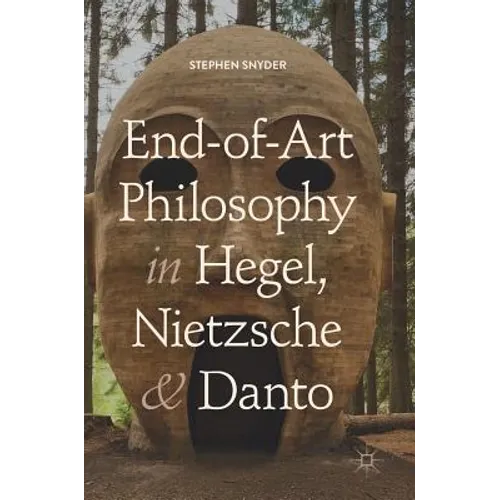
This book examines the little understood end-of-art theses of Hegel, Nietzsche, and Danto. The end-of-art claim is often associated with the end of a certain standard of taste or skill. However, at a deeper level, it relates to a transformation in how we philosophically understand our relation to the 'world'. Hegel, Nietzsche, and Danto each strive philosophically to overcome Cartesian dualism, redrawing the traditional lines between mind and matter. Hegel sees the overcoming of the material in the ideal, Nietzsche levels the two worlds into one, and Danto divides the world into representing and non-representing material. These attempts to overcome dualism necessitate notions of the self that differ significantly from traditional accounts; the redrawn boundaries show that art and philosophy grasp essential but different aspects of human existence. Neither perspective, however, fully grasps the duality. The appearance of art's end occurs when one aspect is given priority: for Hegel and Danto, it is the essentialist lens of philosophy, and, in Nietzsche's case, the transformative power of artistic creativity. Thus, the book makes the case that the end-of-art claim is avoided if a theory of art links the internal practice of artistic creation to all of art's historical forms.
Back Jacket
This book examines the little understood end-of-art theses of Hegel, Nietzsche, and Danto. The end-of-art claim is often associated with the end of a certain standard of taste or skill. However, at a deeper level, it relates to a transformation in how we philosophically understand our relation to the 'world'. Hegel, Nietzsche, and Danto each strive philosophically to overcome Cartesian dualism, redrawing the traditional lines between mind and matter. Hegel sees the overcoming of the material in the ideal, Nietzsche levels the two worlds into one, and Danto divides the world into representing and non-representing material. These attempts to overcome dualism necessitate notions of the self that differ significantly from traditional accounts; the redrawn boundaries show that art and philosophy grasp essential but different aspects of human existence. Neither perspective, however, fully grasps the duality. The appearance of art's end occurs when one aspect is given priority: for Hegel and Danto, it is the essentialist lens of philosophy, and, in Nietzsche's case, the transformative power of artistic creativity. Thus, the book makes the case that the end-of-art claim is avoided if a theory of art links the internal practice of artistic creation to all of art's historical forms.
Author Biography
Stephen Snyder is Visiting Assistant Professor of Philosophy at Boğaziçi University, Istanbul, Turkey and a Fulbright Fellow at Tbilisi State University, Georgia. His research interests are in the philosophy of art and social and political philosophy. He is co-editor of New Perspectives on Distributive Justice (2018). Recent essays appear in Michael Walzer: Sphären der Gerechtigkeit. Ein kooperativer Kommentar (2006), Philosophy in the Contemporary World and Countertext.