Product Description
by Patrick Stakem (Author)
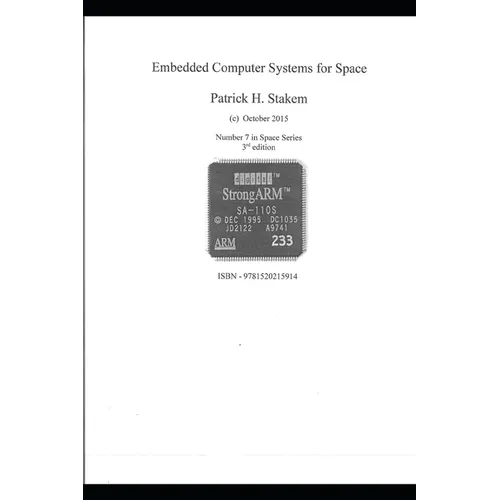
The book covers the topic of Embedded Computers for Spacecraft. We need to define and explore some terms, starting with "embedded computer." We'll look at its cpu, memory, and I/O. The Space environment is harsh, and hard on computer components. We'll review these effects, and see what additional requirements they place upon the system.Just as embedded computers are special cases of computers in general, then space flight embedded computers are a special case of embedded. They are embedded computers which operate in a challenging environment. I make the assumption you know a bit of computer architecture, how instructions are executed, and how how cache works. If not, get a good book or two on computer architecture. There's some in the references. That's our starting point.The flight software, both operating systems and application will be explored. In Space, software is the ideal component. It doesn't weigh anything, doesn't need gravity or air. The environment the embedded system is operating in has a major impact on its design and implementation. The unit may be in Earth orbit, in orbit around another planet, on the surface of another planet, or traversing the solar system. Each of these environments is hostile to equipment, and each is different. Closer to the Sun means hotter, and more radiation. Farther away means less solar power. The large distances involved force slower bandwidth communication, and requires different protocols. In many cases, for long periods of time, spacecraft cannot communicate with Earth-based stations. Spacecraft embedded systems are a special class of embedded. Embedded computers are in just about anything we touch on a daily basis, our cars, our mobile phones and entertainment devices, most of our appliances, traffic light controllers - the list is nearly endless. The earliest satellites did not have computers at all, but the technology quickly evolved to have special purpose-built units. Later, commercial microprocessors were employed, and many failed due to the radiation environment. Now, the latest technologies we use on Earth, multicore, graphics engines, non-volatile magnetic storage, FPGA's, are used in spacecraft electronics. The spacecraft have become networks of computers, or, nodes on a network of space assets.