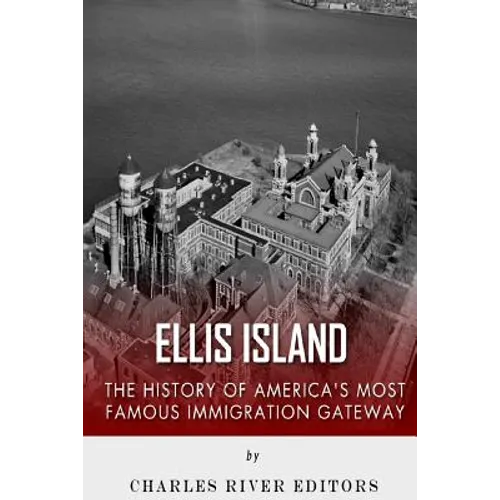
Product Description
by Charles River (Author)
*Includes pictures *Includes accounts of Ellis Island written by immigrants *Includes online resources and a bibliography for further reading *Includes a table of contents "So, anyhow, we had to get off of the ship, and we were put on a tender, which took us across to Ellis Island. And when I saw Ellis Island, it's a great big place, I wondered what we were going to do in there. And we all had to get out of the tender, and then into this, and gather your bags in there, and the place was crowded with people and talking, and crying, people were crying. And we passed, go through some of the halls there, and tried to remember that the halls, big halls, big open spaces there, and there was bars, and there was people behind these bars, and they were talking different languages, and I was scared to death. I thought I was in jail." - Mary Mullins, an Irish immigrant By the middle of the 19th century, New York City's population surpassed the unfathomable number of 1 million people, despite its obvious lack of space. This was mostly due to the fact that so many immigrants heading to America naturally landed in New York Harbor, well before the federal government set up an official immigration system on Ellis Island. At first, the city itself set up its own immigration registration center in Castle Garden near the site of the original Fort Amsterdam, and naturally, many of these immigrants, who were arriving with little more than the clothes on their back, didn't travel far and thus remained in New York. Of course, the addition of so many immigrants and others with less money put strains on the quality of life. Between 1862 and 1872, the number of tenements had risen from 12,000 to 20,000; the number of tenement residents grew from 380,000 to 600,000. One notorious tenement on the East River, Gotham Court, housed 700 people on a 20-by-200-foot lot. Another on the West Side was home, incredibly, to 3,000 residents, who made use of hundreds of privies dug into a fifteen-foot-wide inner court. Squalid, dark, crowded, and dangerous, tenement living created dreadful health and social conditions. It would take the efforts of reformers such as Jacob Riis, who documented the hellishness of tenements with shocking photographs in How the Other Half Lives, to change the way such buildings were constructed. On New Year's Day 1892, a young Irish girl named Annie Moore stepped off the steamship Nevada and landed on a tiny island that once held a naval fort. As she made her way through the large building on that island, Annie was processed as the first immigrant to come to America through Ellis Island. Like so many immigrants before her, she and her family settled in an Irish neighborhood in the city, and she would live out the rest of her days there. Thanks to the opening of Ellis Island near the end of the 19th century, immigration into New York City exploded, and the city's population nearly doubled in a decade. By the 1900s, 2 million people considered themselves New Yorkers, and Ellis Island would be responsible not just for that but for much of the influx of immigrants into the nation as a whole over the next half a century. To this day, about a third of the Big Apple's population is comprised of immigrants today, making it one of the most diverse cities in the world. Ellis Island: The History and Legacy of America's Most Famous Immigration Gateway analyzes the history of Ellis Island and its integral impact on American history. Along with pictures of important people, places, and events, you will learn about Ellis Island like never before, in no time at all.