Product Description
by Errol Miller (Author)
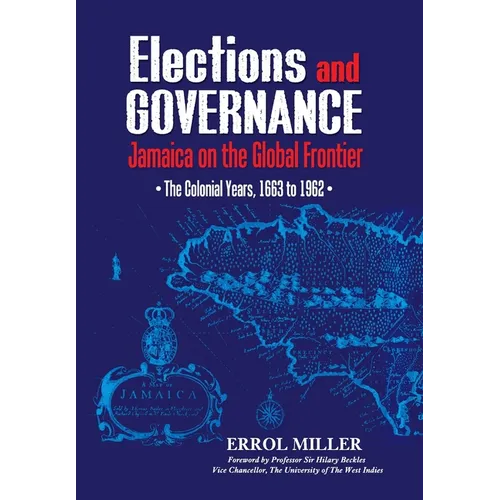
Elections and Governance - Jamaica on the Global Frontier is presented in two books: The Colonial Years, 1663 to 1962 and The Independence Years, 1962 to 2016. Together, they sketch elections and governance in Jamaica as a colony within the British Empire and as a nation-state from 1962 to 2016. Being on the global frontier locates Jamaica in the practice of elections and governance within the Western world but from the perspective of peoples subordinated in that world yet resolutely defiant of domination because of their firm embrace of freedom.
The Colonial Years chronicles the emergence of the English as a people, describes each element that formed the structure of governance and the practice of elections, beginning with Magna Carta in 1215, up to the Civil War and Interregnum in the 1640s and 1650s. English families that restored King Charles II as monarch formed an oligarchy in England that transplanted itself in colonies in North America and the West Indies. Two unsettled questions were the rights of Englishmen in England and the colonies and parity between the House of Commons and elected Assemblies in colonies. These questions were contested in Jamaica up to the mid-twentieth century. The Colonial Years also describes governance and elections among the Akan of Ghana, the Igbo and Ibibio of Nigeria, and the Congo of West Central African prior to their coerced and cruel transportation to West Indies as enslaved. Cultures clashed, creolized, and contended violently. Minority oligarchic power was countered by the power of overwhelming numbers, courage, cunning, and at times reciprocated brutality. Multilateral global connections, Christian Denominations, and a free press all championing competing segments of the society, expanded access to education. Unrestricted sexual unions, enjoyment of rum and bacchanal, and the mobility of the population, all contributed to a sense of common humanity. The Colonial Years documents repeated failure of oligarchic governance, the triumph of the excluded marginal majority in achieving universal adult suffrage, the fear of despotism by all, and the creation of a two-party parliamentary democracy.The Independence Years, 1962 to 2016 chronicles how the nation-state has struggled with its colonial history. It highlights the dilemma of winner-take-all governance; the inherent flaws of democracy in its umbilical connection with elections, in that elected representatives can constitutionally and legally appropriate the sovereign power of the people; and outlines Jamaica's unique attempt to resolve the paradox sustained so far by the electorate and elected representatives. The Independence Years identifies limits of elections and the political process in decolonization, subversive effects of some successful forms of resistance of colonialism and slavery to building a viable state, moral society, and authentic democracy, as well as the risk of regression to oligarchy. It challenges the Jamaica Umbrella Group of Churches, starting with itself, to take the lead in continuing transformation of the Jamaican nation while avoiding nationalistic Christianity.
Number of Pages: 702
Dimensions: 1.69 x 9.21 x 6.14 IN
Publication Date: August 16, 2023