


Product Description
by Steven Wagner (Author)
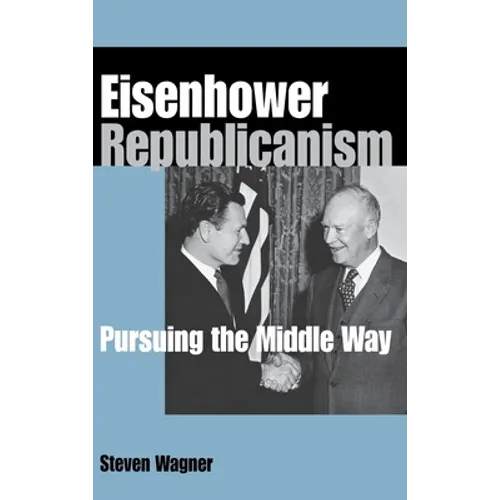
Dwight D. Eisenhower' election to the presidency in 1952 brought an end to two decades of Democratic rule in the White House. His landslide victory, however, masked intense factionalism within the Republican Party. Whereas conservatives were eager to reverse the domestic and foreign policies of past administrations, liberal Republicans favored active federal involvement in Americans' lives and an internationalist approach to affairs abroad. As political historian Steven Wagner demonstrates, Eisenhower sought a "middle way" between Democrats to his left and conservatives to his right.
In American political culture, those who describe themselves as "middle of the road" are often portrayed as unwilling to take a stand or lacking in political sophistication. This was not the case with Eisenhower, whose "middle way" was the result of careful consideration. Despite his party's commitment to limited government, free enterprise, and individual initiative, Eisenhower believed that, in some cases, the federal government needed to intervene.
Eisenhower's enormous popularity with the American people assured him reelection and high approval ratings throughout his two terms of office. This popularity did not, however, translate into legislative success; his proposals were often defeated by an unlikely coalition of liberals and conservatives. Nor did Eisenhower's popularity carry over to his party, a fact driven home by the defeat of his vice president, Richard Nixon, in the 1960 presidential election. In the resulting battle for control of the party, conservatives prevailed. Wagner concludes with a candid discussion of the legacy of "Eisenhower Republicanism" and the ways in which the subsequent conservative victory has continued to shape the party to this day.
Author Biography
Steven Wagner is Associate Professor of History at Missouri Southern State University.



