Product Description
by Peter Soderbaum (Author)
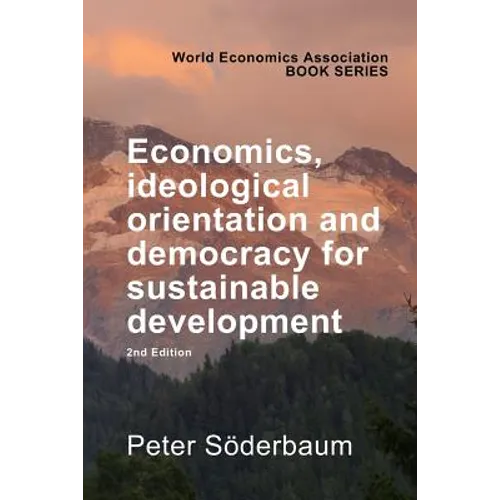
Sustainable development is a challenge for individuals in different roles, for organizations, for communities at local, national and global levels. How can we deal with climate change, biological diversity loss or pollution of land and water? How can social inequality be reduced and democracy strengthened?Can mainstream neoclassical economics be further developed to deal with these issues? While not excluding positive contribution from mainstream economics as part of a pluralist perspective, the main strategy in the book is based on a judgment that new conceptual frameworks and a new economics language is needed. It is even argued that the close to monopoly position of neoclassical theory at university departments of economics globally may be part of the sustainability problems faced.When compared with neoclassical theory 'economics' and 'the economy' are understood in alternative ways. A 'political economic person' replaces 'Economic Man' assumptions. Similarly, the neoclassical profit-maximizing firm is replaced by a 'political economic organization' guided by its 'mission'. Decision-making is seen as a "matching" process where optimization becomes a special case. Positional analysis (PA) is proposed as a more open alternative to cost-benefit analysis (CBA).Democracy is looked upon as an essential part of economics. Value-neutrality is not possible. Instead ideological orientations have to be articulated and discussed openly. A specific interpretation of 'sustainable development' exemplifies an ideological orientation to be compared with 'market and economic growth' ideology for example. To get closer to sustainable development, institutional changes of a more or less radical kind have to be considered.About the author: Peter Söderbaum is professor emeritus in ecological economics at Mälardalen University, Västerås, Sweden and is the author of books such as Ecological Economics (Earthscan, 2000) and Understanding Sustainability Economics (Earthscan, 2008). He is member of the editorial advisory board of Ecological Economics and International Journal of Pluralism and Economics Education.