Product Description
by Rex Oforitse Aruofor (Author)
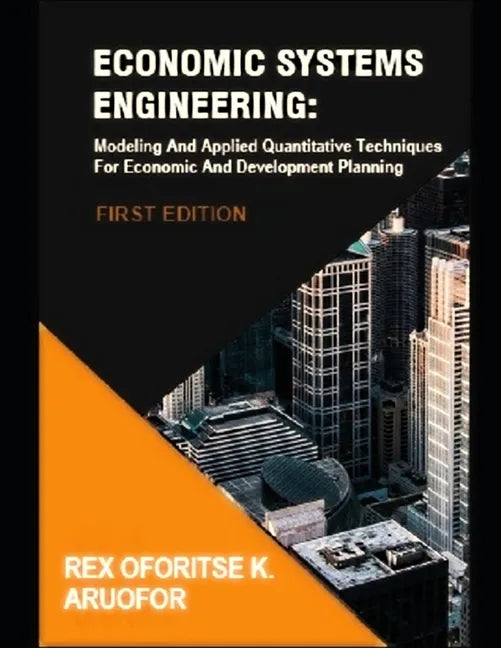
For many years the human race has been striving to develop itself and its environment. The concept of education seems to lend support to this claim. Thus far, it does not appear that the world has been able to grapple satisfactorily with this problem. This is because it will seem that only a third of the world's population have experienced any measure of development or have succeeded in overcoming the problems of poverty since the advent of the industrial revolution about 3 centuries ago which brought modern civilization. This may mean that either our planning is defective, which could be the result of poor understanding of the socio-economic system or that the adequacy of the planning tool kit to deal satisfactorily with the confounding problem of underdevelopment is in question or both.The pervasive and high incidence of poverty, ignorance, disease, squalor, poor diet and poor shelter and the attendant incidences of labour unrest, political instability, inflation, economic bankruptcy, war, and revolutions are indeed a testimony that the planning and management of the world's socio-economic order are still defective. This stresses the need not only to device new approaches but also in addition to carry out a self re-examination or evaluation.This book furnishes a systematic approach to mathematical modeling and empirical research in economics. Indeed the leap from reality or economic theory to mathematical model is often a difficult one and attempts to simplify this step have been haphazard so far. A lot of mathematical tools have been proliferated by mathematicians and the modeling methodology features a wide range of approaches, which include many specialized techniques. These include Mathematics in its own right as a common denominator, Statistics, Econometrics, Systems Analysis, Operations Research, Cybernetics, Simulation, Input-Output Analysis, Cost Benefit Analysis and a host of others. These approaches have been elucidated at international seminars and some of them have acquired the status of disciplines and sub-disciplines. Even though each and every one of the above techniques constitutes a powerful tool by itself, ample opportunity exists to blend them in the solution of economic problems. So far no real effort has been made to harmonize these set of tool kits. Indeed Econometrics one of these sub-disciplines is the translation of economic theory into mathematical formulation and the application of statistical and mathematical methods in characterizing solutions with a view to achieving better economic policies and better focus and control in development. As a tool for development planning, many critics who feel that existing econometric models are unreliable and thus will be dangerous to base development planning and policy decisions on them have attacked it. The inability of mathematicians to communicate effectively with non-mathematicians at one level and also the inability among practitioners to systematize econometric modeling procedures at the other hand might be the source of such suspicious contentions that exist among critics. This thus stresses the need apart from devising new approaches, to reconcile, harmonize and rationalize the above techniques in order to harness their individual strengths more optimally in the solution of economic problems and thus development planning.