


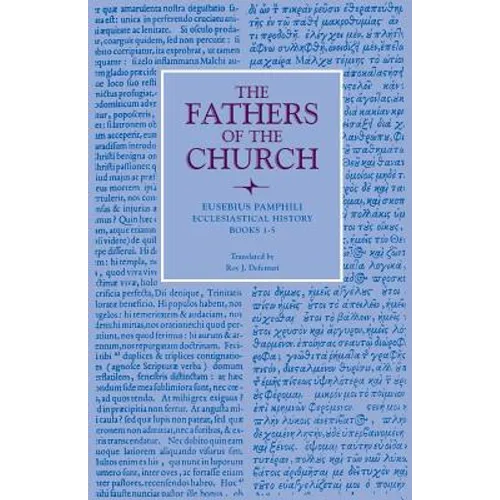
Product Description
by Eusebius (Author), Roy J. Deferrari (Translator)
Eusebius was commonly known among the ancients as Eusebius of Caesarea or Eusebius Pamphili. The first designation arose from the fact that he was bishop of Caesarea for many years; the second from the fact that he was a close friend and admirer of Pamphilus, a proselyte of Caesarea and a martyr. At least forty contemporaries bore the same name, among which the most famous were Eusebius of Samosata--and so arose the necessity of distinguishing him from these others by specific designation.
The year of the Edict of Milan, which divides the first from the second epoch of Church history, does like service for the life and for the literary medium of the Church's first historian. According to the growing assent of scholars, 313 marks off chronologically the Alexandrian from the Byzantine period of Greek literature, and it is 313 that cleaves into uneven but appropriate parts that career of Eusebius Pamphilil. In training and in literary taste, Eusebius belongs to the earlier time. Officially and in literary productivity, he belongs to the later. It was shortly after 313 that Eusebius became a bishop, as it was, for the most part, after 313 that his works were actually composed. Of events contemporary with these later years, Eusebius recorded much that is valued, but it is for what he tells of the earlier period--of the days before the Peace of the Church--that he looms so large in the history of history and of literature. Through him--through him almost alone--are preserved to us the feeble memories of an age that died with himself.
Of the facts of his life we know little. Neither the place nor the year of this birth is known. The best conjecture makes Palestine his native land and assigns to the period 260-264 the date of his birth. Caesarea in Palestine may have been his native city. All the known associates of his youth at any rate, and the chief activities of his maturity, are linked with her. He was certainly not born a Jew, but that he was born a Christian we do not know. His parents, whether pagan or Christian, were not of high rank. The fact that Arius, when writing to Eusebius of Nicomedia, refers to his namesake of Caesarea as 'your brother who is in Caesarea' cannot with confidence be taken literally. Arius might well call them brothers because they were associated in theological sympathies as well as in episcopal office. Of his parentage and relationship, then, essentially nothing is known.



