


Product Description
by Duncan Sayer (Author)
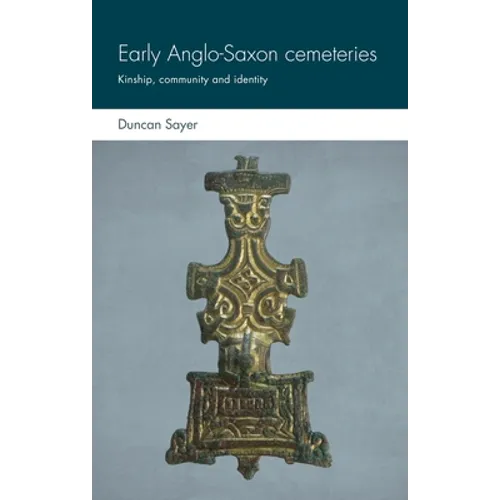
This book moves beyond the examination of grave goods to place community at the forefront of cemetery studies. It reveals that early Anglo-Saxon cemeteries were pluralistic, multi-generational places where the physical communication of digging a grave was used to construct family and community stories.
Front Jacket
Early Anglo-Saxon cemeteries are well-known for their rich grave goods, but this wealth can obscure their importance as a local phenomenon and the product of pluralistic, multi-generational communities. This book explores over one hundred early Anglo-Saxon and Merovingian cemeteries, seeking to understand them using a multi-dimensional methodology. The performance of mortuary drama was a physical communication, which means it required syntax and semantics. This local knowledge was used to negotiate the arrangement of cemetery spaces and to construct the stories that were told within them. For some families the emphasis of a mortuary ritual was on reinforcing and reproducing family narratives, but this was only one technique used to arrange cemetery space. The book offers an alternative way to explore the horizontal organisation of cemeteries from a holistic perspective. Each chapter builds on the last, using a variety of criteria - including visual aesthetics, spatial statistics, grave orientation, mortuary ritual, grave goods, skeletal trauma, stature, gender and age -- to build a detailed picture of complex mortuary spaces. This approach places community at the forefront of interpretation, since people used and reused cemetery spaces, emphasising different characteristics of the deceased because of their own attitudes, lifeways and live experiences. Proposing a way to move beyond grave goods in the discussion of complex social identities, this book will appeal to scholars of Anglo-Saxon studies and to archaeologists interested in mortuary spaces, communities and social differentiation.
Back Jacket
Early Anglo-Saxon cemeteries are well-known for their rich grave goods, but this wealth can obscure their importance as a local phenomenon and the product of pluralistic, multi-generational communities. This book explores over one hundred early Anglo-Saxon and Merovingian cemeteries, seeking to understand them using a multi-dimensional methodology.
The performance of mortuary drama was a physical communication, which means it required syntax and semantics. This local knowledge was used to negotiate the arrangement of cemetery spaces and to construct the stories that were told within them. For some families the emphasis of a mortuary ritual was on reinforcing and reproducing family narratives, but this was only one technique used to arrange cemetery space. The book offers an alternative way to explore the horizontal organisation of cemeteries from a holistic perspective. Each chapter builds on the last, using a variety of criteria - including visual aesthetics, spatial statistics, grave orientation, mortuary ritual, grave goods, skeletal trauma, stature, gender and age -- to build a detailed picture of complex mortuary spaces. This approach places community at the forefront of interpretation, since people used and reused cemetery spaces, emphasising different characteristics of the deceased because of their own attitudes, lifeways and live experiences. Proposing a way to move beyond grave goods in the discussion of complex social identities, this book will appeal to scholars of Anglo-Saxon studies and to archaeologists interested in mortuary spaces, communities and social differentiation.Author Biography
Duncan Sayer is Professor of Archaeology at the University of Central Lancashire