


Product Description
by Michelle a. Parsons (Author)
In the early 1990s, Russia experienced one of the most extreme increases in mortality in modern history. Men's life expectancy dropped by six years; women's life expectancy dropped by three. Middle-aged men living in Moscow were particularly at risk of dying early deaths. While the early 1990s represent the apex of mortality, the crisis continues. Drawing on fieldwork in the capital city during 2006 and 2007, this account brings ethnography to bear on a topic that has until recently been the province of epidemiology and demography.
Middle-aged Muscovites talk about being unneeded (ne nuzhny), or having little to give others. Considering this concept of "being unneeded" reveals how political economic transformation undermined the logic of social relations whereby individuals used their position within the Soviet state to give things to other people. Being unneeded is also gendered--while women are still needed by their families, men are often unneeded by state or family. Western literature on the mortality crisis focuses on a lack of social capital, often assuming that what individuals receive is most important, but being needed is more about what individuals give. Social connections--and their influence on health--are culturally specific.
In Soviet times, needed people helped friends and acquaintances push against the limits of the state, crafting a sense of space and freedom. When the state collapsed, this sense of bounded freedom was compromised, and another freedom became deadly.
This book is a recipient of the annual Norman L. and Roselea J. Goldberg Prize for the best project in the area of medicine.
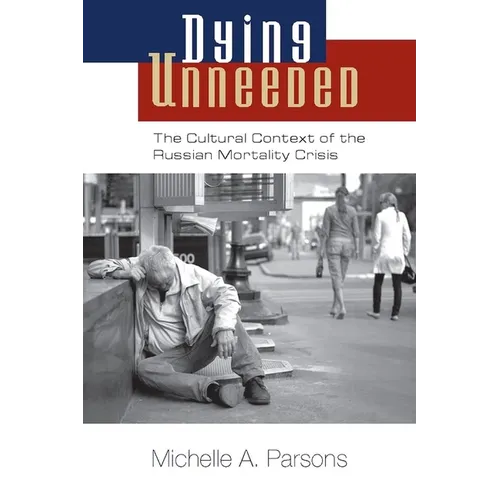
Front Jacket
How the country's mortality crisis is as much about how Russians live as about how they die
Author Biography
Michelle A. Parsons is a sociocultural anthropologist with a background in global health. She has lived in Latin America, Spain, Switzerland, Indonesia, and Russia, working for non-governmental organizations and the World Health Organization. She currently teaches at Emory University.



