


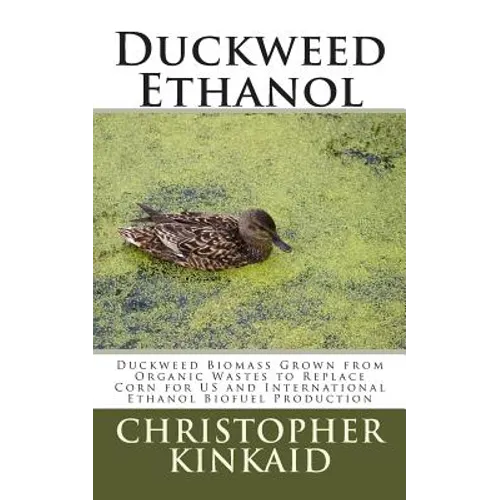
Product Description
by Christopher Kinkaid (Author)
The smallest flowering plant, on Earth, is one of the most powerful, and widespread: duckweed. Usually, considered a nuisance, duckweed, upon close examination, is an impressive crop, in photosynthetic value. Ethanol, an industry dominated by the Corn Industry (King Corn), faces many challenges, including large water draws, rising fertilizer costs, large diesel fuel bills, and unintended impacts on Food markets. Corn, as a choice for ethanol production, pits food, versus fuel, for agricultural resources, increasing stresses between fundamental markets. An ideal source of biomass, for ethanol production, would not be a food crop, rather, a waste-crop. King Corn, dominates current domestic ethanol production markets, worth billions, each year. Supported with Federal Farm Subsidies, worth billions of dollars annually, the corn industry dictates the US ethanol markets, using Corn as the principle feedstock crop. At first glance, Corn, is an odd choice for ethanol production. Corn, began as a wild seed crop, domesticated by ancient man. Before the modern age, thousands of years of selective breeding, produced a Corn rich in proteins, and high in nutritional value. Modern Corn, has been engineered to go "the other direction," and reduce Corn's Protein, and increase Corn's Starch (Carbohydrate) production. The "Starch" in corn, is used for Ethanol production, and other by-products, such as Corn Syrup, and Distillers Dried Grains and Solubles (DDGS). Duckweed, is a choice for bulk biomass, which offers significant advantages over corn. Duckweed advantages include, lower energy costs, lower water resources, lower fertilizer costs, doesn't require valuable farmland, doesn't compete in Food markets, has higher Starch yield, per acre. Duckweed, in a controlled environment, can be grown, year round, and in diverse locations. Corn, as a bulk source of Starch production, competes with Food markets, drinks thousands of gallons of water, per gallon Ethanol produced, requires large diesel fuel bills for growing, and harvesting, requires large amounts of fertilizers, and lower's the nutritional value of Corn on purpose, to produce more starch, reducing protein production, and nutritional value.
Author Biography
Christopher (Toby) Kinkaid, originally from Portland, Oregon, is the founder of Solardyne.com, SolarQuote.com, and AlgaeToday.com, and has worked in clean energy technology for over three decades. Kinkaid, is the inventor of the "Helyx" Vertical Axis Wind Generator, the "Mariposa" Non-imaging solar concentrator PV module (continuous operation at Sandia National Laboratory since 1994), the Solar Demultiplexer optical solar concentrating lens (Dr. James/Sandia National Laboratory 1991), and the inventor of the original "Solar Power Pack" (Mother Earth News, "Littlest Utility" June/July, 2001). Kinkaid, has lectured on clean energy technology around the world including "APEC", Bangkok, Thailand, 2003, "Energy Solutions World", Tokyo, Japan, 2003, The International Biomass Conference (IBC), 2010, Minneapolis, MN, and the Algal Biomass Organization (ABO) Conference, 2010, Phoenix, AZ. Christopher (Toby) Kinkaid, has appeared in interviews on KOIN TV, KGW TV, and "Sustainable Today" produced in Oregon, and has served on the board of directors for the National Hydrogen Association, in Washington D.C., 1993, the Japan Satellite Communications Company (JCNET), Fukuoka, Japan, 1994-95, and Algaedyne Corporation, St. Paul, MN, 2010-2013. Kinkaid, presently serves as CEO of Solardyne, LLC in Portland, Oregon, where he continues his work in Solar, Wind, and Biomass Technology applications, research, and development.



