Product Description
by Thomas A. Cole (Author)
A practical guide to more fully achieving a meritocratic society.
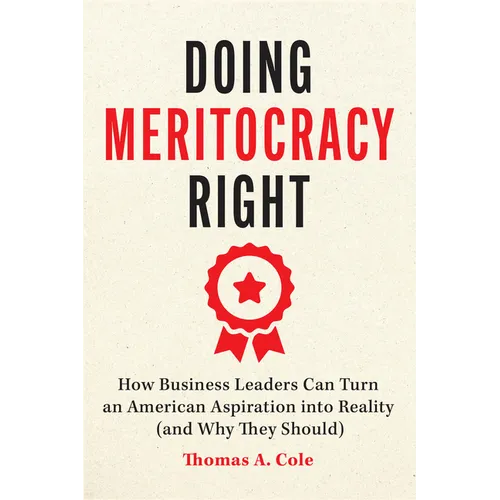
As America's most vaunted cultural value, meritocracy is celebrated by some as an institution and derided by others as a myth--or even a trap. Thomas A. Cole argues in Doing Meritocracy Right that if meritocracy is to persist as an institution--and it must--it requires structural support in the private sector. For America to achieve a version of meritocracy that more closely matches our aspirations, our business leaders must first offer equity of opportunity for individuals to demonstrate and develop their talents on equal terms. Drawing on his decades of experience in advising CEOs and corporate boards, personally serving on the boards of major not-for-profits, and leading a large global law firm, Cole cites elite professional-service institutions--consultancies and law firms especially--as improbable laboratories for equity of opportunity. These workplaces, out of self-interest, are laser-focused on the quality of their professionals, seeking out talent and representation and then judging these individuals on (ideally) equal terms once they're in place. Here, Cole sees an opportunity that no public initiative or platitudes can deliver: if workplaces seek out representational diversity by applying, with thought and care, a single standard of merit--one that emphasizes character--and by providing training and mentoring on an equitable basis, then they will offer a ladder to social and economic mobility that serves both individuals and society. Cole argues that a meritocratic society is achieved in two interrelated stages: access to education; and post-education promotion to membership in the elite. The latter, he says, is the domain of business. Cole argues that the private sector is better positioned to effect reform and he encourages leaders in the private sector to pursue reform both in their organizations, in government, and in the universities and communities where they have influence. Meritocracy in the private sector can't control the many American inequities that exist on the ground of American society. But it can do social good by serving as a reliable, merit-determined path to the highest echelons of business and industry. Cole sets the stage for the discussion of reforms with a "brief history of our imperfect meritocracy," and rounds out the book with a to-do list for business leaders.Author Biography
Thomas A. Cole is chair emeritus of the executive committee of Sidley Austin LLP, a global law firm. He is the author of CEO Leadership: Navigating the New Era in Corporate Governance and coauthor of Collaborative Crisis Management: Prepare, Execute, Recover, Repeat, both also published by the University of Chicago Press.
Number of Pages: 192
Dimensions: 0.6 x 8.49 x 5.63 IN
Publication Date: December 03, 2025