


Product Description
by Tania Begazo (Author), Moussa Blimpo (Author), Mark Dutz (Author)
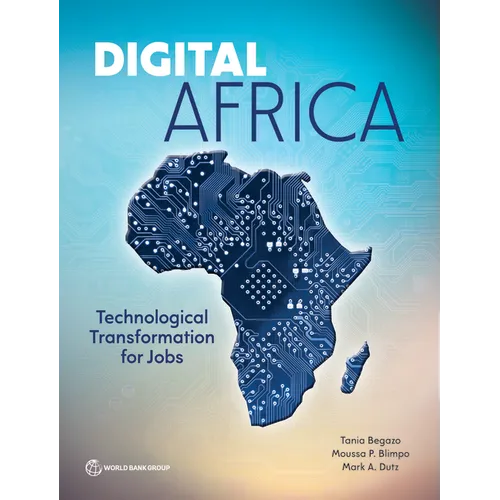
All African countries need better and more jobs for their growing populations. 'Digital Africa: Technological Transformation for Jobs' shows that broader use of productivity-enhancing digital technologies by enterprises and households is imperative to generate such jobs, including for lower-skilled people. At the same time, broader use can support not only countries' short-term objective of postpandemic economic recovery but also their vision of economic transformation with more inclusive growth. These outcomes are not automatic, however. Mobile internet availability has increased throughout the continent in recent years, but Africa's uptake gap is the highest in the world. Areas with at least 3G mobile internet service now cover 84 percent of country populations averaged across Sub-Saharan Africa, but only 22 percent use such services. The average African business lags in the use of smartphones and computers, as well as more sophisticated digital technologies that catalyze further productivity gains. Two issues explain the usage gap: the affordability of these new technologies and the willingness to use them. For the 40 percent of Africans below the extreme poverty line, mobile data plans alone would cost one-third of their incomes--in addition to the price of access devices, apps, and electricity. Data plans for small and medium businesses are also more expensive than in other regions. Moreover, shortcomings in the quality of internet services--and in the supply of attractive, skill-appropriate apps that promote entrepreneurship and raise earnings--dampen people's willingness to use them. For those countries already using these technologies, the development payoffs are significant. New empirical studies for this report add to the rapidly growing evidence that mobile internet availability directly raises enterprise productivity, increases jobs, and reduces poverty across Africa. To realize these and other benefits more widely, Africa's countries must implement complementary and mutually reinforcing policies to strengthen both consumers' ability to pay and willingness to use digital technologies. These interventions must prioritize productive use to generate large numbers of inclusive jobs in a region poised to benefit from a massive, youthful workforce--one projected to become the world's largest by the end of this century.
Author Biography
The World Bank came into formal existence in 1945 following the international ratification of the Bretton Woods agreements. It is a vital source of financial and technical assistance to developing countries around the world. The organization's activities are focused on education, health, agriculture and rural development, environmental protection, establishing and enforcing regulations, infrastructure development, governance and legal institutions development. The World Bank is made up of two unique development institutions owned by its 185 Member Countries. The International Bank for Reconstruction and Development (IBRD) focuses on middle income and creditworthy poor countries and the International Development Association (IDA), which focuses on the poorest countries in the world.