


Product Description
by Aybars Aş?ı (Author)
In today's polarized world, we are increasingly pulled into echo chambers where it becomes harder to understand perspectives other than our own. To have a pluralistic worldview, we need to learn how to consider other vantage points. Can we be nudged to do that?
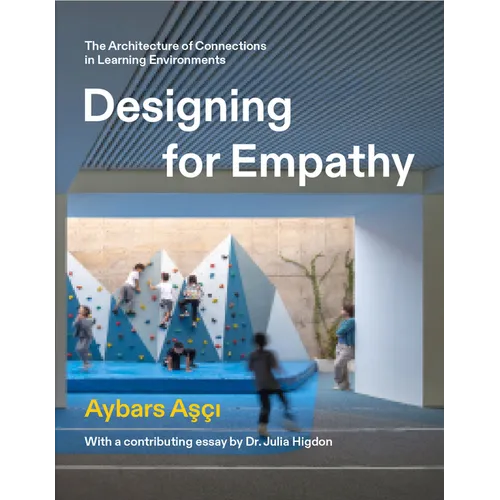
Designing for Empathy: The Architecture of Connections in Learning Environments explores the deep, inextricable relationship between developmental psychology and our physical environment. By connecting perspective taking in psychology to perspectival space in architecture, the book defines the geometry of empathy, and it postulates that the forces that operate in our spatial cognition can also shift perspectives, thereby helping us develop empathy. The critical question guiding the book is: how can architecture influence human development, and by extension, how can concepts of empathy in development be influenced and catalyzed by architecture? Planners, architects, and designers are responsible for shaping our physical environment--from our homes, schools, and cultural and religious centers to the wider neighborhoods and cities within which human development takes place. However, architecture is conspicuously absent in most development theories, even though the environment is omnipresent. Through research and design, architect Aybars Aş?ı explores spatial constructs across a range of scales that situate learning environments through interpenetrations with their context, while also catalyzing narratives that are generated through translations between different people, forms of life, ideas, emotions, images, languages, and cultures. The premise of this approach is the collective rethinking of the learning environments, one that will inherently be more empathic as its spatial narratives are constructed through the interactions of its learners.
Number of Pages: 232
Dimensions: 0.8 x 9 x 7 IN
Publication Date: September 24, 2024



