Product Description
by Carl F. Zorowski (Author)
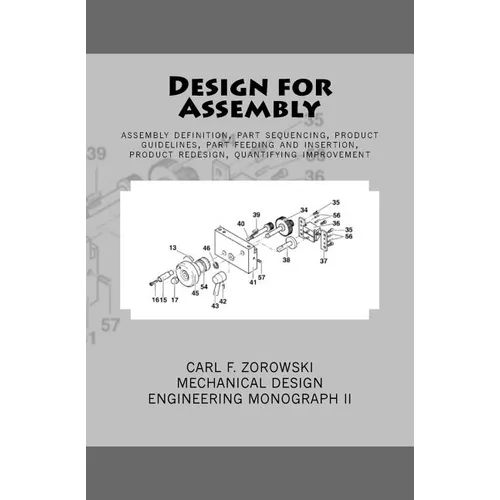
This second monograph in the Mechanical Design Engineering Series deals with the subject of Design for Assembly. It consists of five chapters whose content descriptions follow. Chapter-1 deals with the importance of DFA, an operational definition of assembly, part characterization, reasons for separate parts and creating a apart sequence diagram. Chapter-2 presents and discusses with examples generally accepted DFA product development guidelines. These include: providing a base for assembly, layering and stacking, using multi-functional parts, accommodating for errors, reducing fasteners, limiting flexible items and minimizing part count. Chapter-3 discusses the design of parts to facilitate their feeding and insertion. Topics include the avoidance of tangling, overlapping and nesting, the role of gravity, the value of geometric symmetry and the use of asymmetry. Chapter-4 presents a four-step process for applying DFA principles to the improvement of existing products. A number of examples of the process application are included and discussed in detail. Chapter-5 introduces a technique that numerically quantifies the ease of assembly based on the feeding, insertion and fastening of parts. It is used to quantitatively compare the degree of improvement that DFA can make in a number of product examples.
Author Biography
Carl F. Zorowski is R. J. Reynolds Professor Emeritus of Mechanical and Aerospace Engineering at North Carolina State University. He attended Carnegie Mellon University, earned his doctorate in 1956, taught there until 1962 before going to North Carolina State University. His academic carreer at NCSU included teaching, research, outreach and administration. He served as Head of Mechanical and Aerospace Engineering and Associate Dean for Academic Affair in the College of Engineering. He cofounded and has directed the Integrated Manufacturing Systems Institute, an early inter-disciplinary master's practice program. His passion is classroom instruction, course content development and delivery methods emphasizing mathematical modeling and design performance analysis of mechanical systems. From 1993 to 1997 he directed the NSF South Eastern University and College Coalition for Engineering Education dedicated to revitalizing undergraduate engineering curricula. Following retirement in 1997 he has offered courses in Mechanical Design Engineering for the college's distance education master's degree program. He is a fellow of the American Society of Engineering Education and the American Society of Mechanical Engineers.