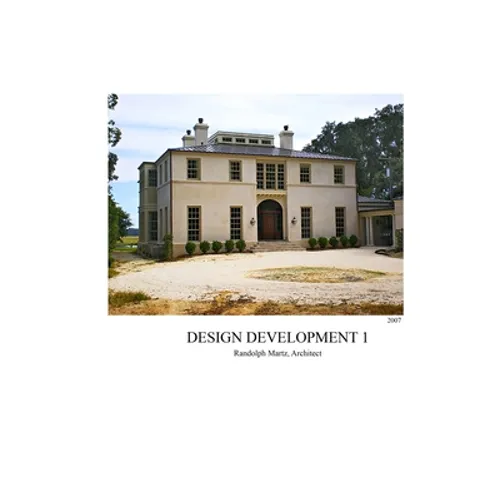
Product Description
by Randolph Martz (Author)
Randolph Martz has a degree in architecture from Carnegie-Mellon University, where he was trained to design in the Modern Style, but while there he also took courses in architectural history. His longest period of apprenticeship was with the H. A. De Costa Company, which specialized in the restoration of 18th and 19th Century buildings, and his practical training and worldwide travels increased his appreciation of historic architecture. Gradually, he moved away from the minimalist and intolerant approach of Modern architects and developed a style of his own based on his increasing knowledge of all styles of architecture.
During his apprenticeship from 1976 to 1984, he developed his skills further by designing houses for imaginary clients; and after becoming a registered architect in 1984, he continued this practice until he had so many clients that he needed to hire and train apprentices himself. Since 1984, more than 100 of his buildings have been constructed primarily in South Carolina, Georgia, Florida, and North Carolina but also in Connecticut and Michigan. In addition, he has renovated hundreds of historic buildings. Most of his constructed buildings are illustrated and many are discussed in the first volume of Randolph Martz, Architect (a separate series of two volumes with a second volume of his photographs of buildings worldwide).
Of the more than 2,300 pages of designs Martz drew early in his career, he selected and bound 361 of them that were made before he was registered, and with several exceptions they are reproduced in this volume, which documents his development as an architect. An additional 400 drawings will be published in a second volume that will include a substantial text in which he discusses his sources of inspiration, his reasons for the plans he drew, and more elaborate presentations. He also made models of some designs, and photographs of the models are included as appendices in both volumes.
The individual style that Martz developed is characterized by large, versatile, and exceptionally well lighted rooms with unusual shapes. His plans are highly functional, and his elevations reflect his unusual plans and are nonetheless compact and well unified. The style chosen for any given building depends to a large extent on its setting and his clients' preferences, but his well informed advice is usually accepted.
For architectural students, the principal value of these two volumes in their approach for developing designs and an individual style. A student who continues to teach himself is most likely to succeed, and the best way to know how to design is to learn what was required to produced the world's most widely admired buildings.