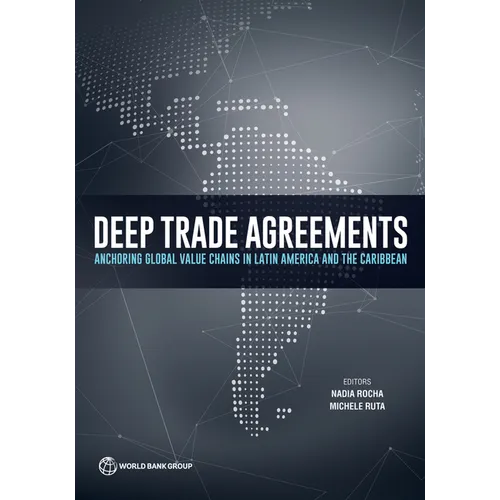
Product Description
by Nadia Rocha (Author), Michele Ruta (Author)
Globally, greater integration in international trade and global value chains (GVCs) has been linked to increased GDP per capita and productivity. Latin American and Caribbean (LAC) countries have displayed limited trade openness and weak integration into GVCs. Their trade is roughly one-third of GDP on average, compared with one-half in countries in Europe and Central Asia, as well as East Asia and the Pacific-and that share has not grown since 2000.
Although the gaps between potential and actual GVC integration are the result of economic fundamentals-such as geography, market size, institutions, and factor endowments-policy choices matter as well. The region has untapped potential in trade and GVCs to grow in the wake of COVID-19 (coronavirus).
Deep trade agreements are reciprocal agreements between countries that seek integration of goods, services, and factors' markets, or deep integration. Drawing on new data and evidence, Deep Trade Agreements: Anchoring Global Value Chains in Latin America and the Caribbean shows that these agreements can drive policy reforms that can help the region overcome some of its disadvantageous fundamentals.
Four areas of deep integration-trade facilitation, regulatory cooperation, services, and state support-are priorities to improve the participation of countries in the region in GVC:
1.Facilitating trade can reduce border delays and ease the challenges caused by the remoteness of some countries.
2.Improving regulatory cooperation can help create larger regional markets by reducing the costs of nontariff measures.
3.Opening the service economy can compensate for factor endowment scarcity and facilitate access to skills and technology.
4.Fostering competition and regulating state support and state-owned enterprises can improve the quality of economic institutions.
These areas are increasingly important as global trade tensions persist and economies recover from the COVID-19 pandemic. In these times of uncertainty and upheaval, the policy commitments in deep trade agreements can create a more stable
institutional environment to promote the ability of countries to participate in
GVCs and to reap the benefits of integration.
This work is a product of the regional studies program sponsored by the Latin
America and the Caribbean Chief Economist's Office.
Author Biography
The World Bank came into formal existence in 1945 following the international ratification of the Bretton Woods agreements. It is a vital source of financial and technical assistance to developing countries around the world. The organization's activities are focused on education, health, agriculture and rural development, environmental protection, establishing and enforcing regulations, infrastructure development, governance and legal institutions development. The World Bank is made up of two unique development institutions owned by its 185 Member Countries. The International Bank for Reconstruction and Development (IBRD) focuses on middle income and creditworthy poor countries and the International Development Association (IDA), which focuses on the poorest countries in the world.