


Product Description
by Joseph H. Yuen (Editor), National Aeronautics and Administration (Author)
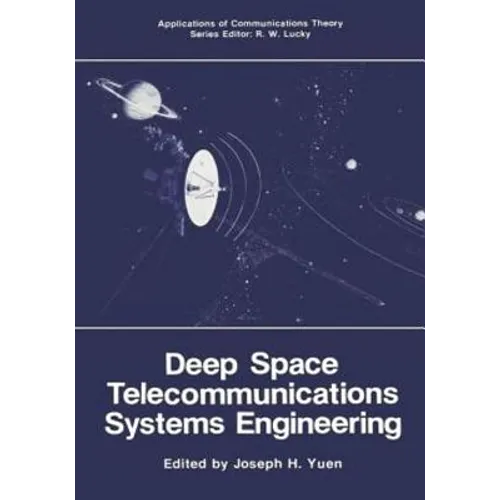
A vital, often predominant function in every space mission is that of communications. From the moment of launch, the only connection between spacecraft and earth is the communications system. This system is responsible for sending scientific data back to earth in the specified quality and quantity together with engineering data reporting the condition of the spacecraft. The communications system also provides the capability of tracking the spacecraft and commanding it to take certain actions. Without an effective communications system a successful mission would not be possible. To appreciate the challenge that one faces in designing such systems for planetary exploration, one must consider the enormous distances that are involved. Voyager spacecraft, for example, are now more than one billion miles from earth, tens of thousands of times farther than the most distant communications satellite, and continue to transmit data and respond to commands. The necessity of minimizing spacecraft weight presents a major problem to communications systems designers. The far-reaching implications of spacecraft weight become apparent as the designer considers the problems of providing power supply, antennas, and other necessary devices and supporting elements. Another important challenge is the extreme reliability required of the communications system on the spacecraft. Once the spacecraft is launched, on-board failures can no longer be repaired except by use of redundant systems. System degradation due to aging, imperfect antenna pointing, or imperfect trajectories can be expected; and the designer must know how much degradation to expect from each case and must design the equipment, the operations, and the procedures of data analysis accordingly. The telecommunications engineer works with the most precise and advanced techniques of the engineering world. Since the launch in 1958 of Explorer I, the first free-world satellite, there has been substantial progress in improving communications capability. Even though substantial progress has been made in the last 25 years, space exploration is still in its infancy. There has been no exploration beyond the solar system. There are numerous galaxies and billions of stars to investigate. Bigger and tougher challenges are still ahead; more exciting times are yet to come. These challenges will undoubtedly call for more advanced telecommunications systems to transmit information to and from deep space. Telecommunications technology is still in its infancy. Through the years, a number of telecommunications design techniques, procedures, and analyses contributing to the success of deep space exploration missions have been developed and applied. The purpose of this book is to provide descriptive and analytical information useful for the optimum design, specification, and performance evaluation of deep space telecommunications systems. The book emphasizes system performance information. Long, tedious derivations are not included. The book should serve to acquaint new telecommunications engineers with the techniques available to them and should summarize for the experienced engineers the analyses and information necessary for their work. It also provides a background for understanding the interface between the Deep Space Network and the spacecraft and is intended to facilitate the conceptual designs and analyses for the enhancement of telecommunications performance and assurance of compatibility between spacecraft and ground system capabilities.