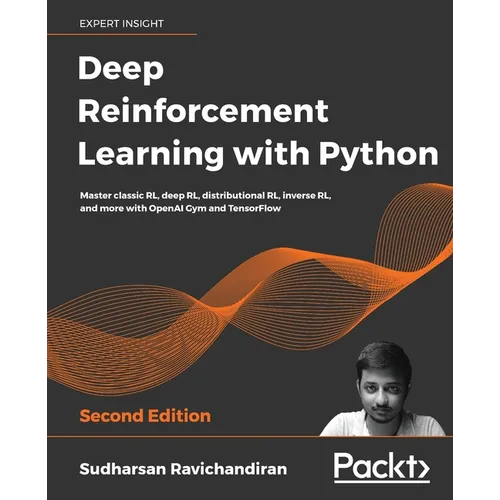
Product Description
by Sudharsan Ravichandiran (Author)
An example-rich guide for beginners to start their reinforcement and deep reinforcement learning journey with state-of-the-art distinct algorithms
Key Features
- Covers a vast spectrum of basic-to-advanced RL algorithms with mathematical explanations of each algorithm
- Learn how to implement algorithms with code by following examples with line-by-line explanations
- Explore the latest RL methodologies such as DDPG, PPO, and the use of expert demonstrations
Book Description
With significant enhancements in the quality and quantity of algorithms in recent years, this second edition of Hands-On Reinforcement Learning with Python has been revamped into an example-rich guide to learning state-of-the-art reinforcement learning (RL) and deep RL algorithms with TensorFlow 2 and the OpenAI Gym toolkit.
In addition to exploring RL basics and foundational concepts such as Bellman equation, Markov decision processes, and dynamic programming algorithms, this second edition dives deep into the full spectrum of value-based, policy-based, and actor-critic RL methods. It explores state-of-the-art algorithms such as DQN, TRPO, PPO and ACKTR, DDPG, TD3, and SAC in depth, demystifying the underlying math and demonstrating implementations through simple code examples.
The book has several new chapters dedicated to new RL techniques, including distributional RL, imitation learning, inverse RL, and meta RL. You will learn to leverage stable baselines, an improvement of OpenAI's baseline library, to effortlessly implement popular RL algorithms. The book concludes with an overview of promising approaches such as meta-learning and imagination augmented agents in research.
By the end, you will become skilled in effectively employing RL and deep RL in your real-world projects.
What you will learn
- Understand core RL concepts including the methodologies, math, and code
- Train an agent to solve Blackjack, FrozenLake, and many other problems using OpenAI Gym
- Train an agent to play Ms Pac-Man using a Deep Q Network
- Learn policy-based, value-based, and actor-critic methods
- Master the math behind DDPG, TD3, TRPO, PPO, and many others
- Explore new avenues such as the distributional RL, meta RL, and inverse RL
- Use Stable Baselines to train an agent to walk and play Atari games
Who this book is for
If you're a machine learning developer with little or no experience with neural networks interested in artificial intelligence and want to learn about reinforcement learning from scratch, this book is for you.
Basic familiarity with linear algebra, calculus, and the Python programming language is required. Some experience with TensorFlow would be a plus.