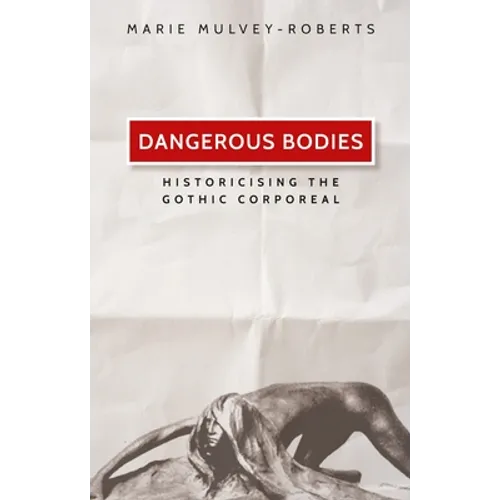
Product Description
by Marie Mulvey-Roberts (Author)
"Through an investigation of the body and its oppression by the church, the medical profession and the state, this book reveals the actual horrors lying beneath fictional horror in settings as diverse as the monastic community, slave plantation, operating theatre, Jewish ghetto and battlefield trench. The book provides original readings of canonical Gothic literary and film texts including The Castle of Otranto, The Monk, Frankenstein, Dracula and Nosferatu. This collection of fictionalised dangerous bodies is traced back to the effects of the English Reformation, Spanish Inquisition, French Revolution, Caribbean slavery, Victorian medical malpractice, European anti-Semitism and finally warfare, ranging from the Crimean up to the Vietnam War. The endangered or dangerous body lies at the centre of the clash between victim and persecutor and has generated tales of terror and narratives of horror, which function to either salve, purge or dangerously perpetuate such oppositions. This
ground-breaking book will be of interest to academics and students of Gothic studies, gender and film studies and especially to readers interested in the relationship between history and literature."
Front Jacket
The body is a potential marker of monstrosity, identifying those who do not fit into the body politic. Irregularity and the grotesque have been associated with Gothic architecture and are also indicative of wayward flesh and its deformities. Through an investigation of the body and its oppression by the church, the medical profession and the state, Dangerous bodies reveals the actual horrors lying beneath fictional horror in settings as diverse as the monastic community, slave plantation, operating theatre, Jewish ghetto and battlefield trench. Original readings of canonical Gothic literary and film texts include The Castle of Otranto, The Monk, Frankenstein, Dracula and Nosferatu. This collection of fictionalised dangerous bodies is traced back to the effects of the English Reformation, Spanish Inquisition, French Revolution, Caribbean slavery, Victorian medical malpractice, European anti-Semitism and finally warfare, ranging from the Crimean up to the Vietnam War. Dangerous bodies demonstrates how the Gothic corpus is haunted by a tangible sense of corporeality, often at its most visceral. Chapters set out to vocalise specific body parts such as skin, genitals, the nose and eyes, as well as blood. The endangered or dangerous body lies at the centre of the clash between victim and persecutor and has generated narratives of terror and horror, which function to either salve, purge or perpetuate such oppositions. This ground-breaking book will be of interest to academics and students of Gothic studies, gender and film studies and especially to readers interested in the relationship between history and literature.
Back Jacket
The body is a potential marker of monstrosity, identifying those who do not fit into the body politic. Irregularity and the grotesque have been associated with Gothic architecture and are also indicative of wayward flesh and its deformities. Through an investigation of the body and its oppression by the church, the medical profession and the state, Dangerous bodies reveals the actual horrors lying beneath fictional horror in settings as diverse as the monastic community, slave plantation, operating theatre, Jewish ghetto and battlefield trench.
Original readings of canonical Gothic literary and film texts include The Castle of Otranto, The Monk, Frankenstein, Dracula and Nosferatu. This collection of fictionalised dangerous bodies is traced back to the effects of the English Reformation, Spanish Inquisition, French Revolution, Caribbean slavery, Victorian medical malpractice, European anti-Semitism and finally warfare, ranging from the Crimean up to the Vietnam War. Dangerous bodies demonstrates how the Gothic corpus is haunted by a tangible sense of corporeality, often at its most visceral. Chapters set out to vocalise specific body parts such as skin, genitals, the nose and eyes, as well as blood. The endangered or dangerous body lies at the centre of the clash between victim and persecutor and has generated narratives of terror and horror, which function to either salve, purge or perpetuate such oppositions. This ground-breaking book will be of interest to academics and students of Gothic studies, gender and film studies and especially to readers interested in the relationship between history and literature.Author Biography
Marie Mulvey-Roberts is Associate Professor in English Literature at the University of the West of England, Bristol