


Product Description
by Elaine Weiss (Author), Bruce Levine (Author), Kimberly Sterin (Author)
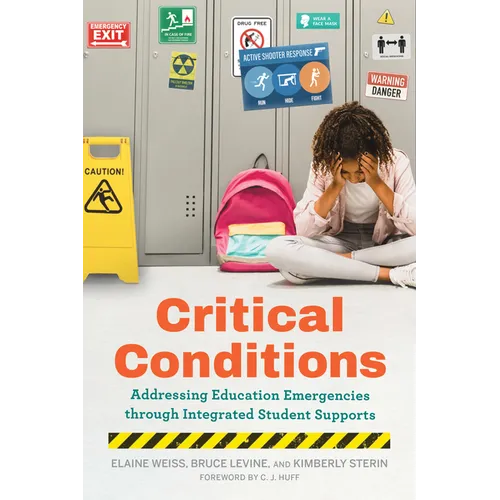
In Critical Conditions, Elaine Weiss, Bruce Levine, and Kimberly Sterin outline successful strategies for whole child and whole community support that can help school systems meet broader student needs in times of disruption. They take a deep look at Integrated Student Supports (ISS), an approach to education policy and practice aligned with Maslow's hierarchy of needs, in which schools focus on attending to students' basic physical, social, and emotional needs before learning occurs. Providing indispensable insight, Weiss, Levine, and Sterin demonstrate how the ISS approach is especially effective in educational contexts rocked by trauma and crisis.
The work draws on extensive research on the ISS model in theory and practice, as well as case studies of five very different communities across the United States--Berea, Kentucky; Salem, Massachusetts; Grain Valley, Missouri; Minneapolis, Minnesota; and Frederick County, Virginia--that had been using ISS when the COVID-19 pandemic closed schools. It highlights how the planning, flexibility, and wraparound services central to ISS improve the capacity of education systems to confront a wide variety of emergency situations, from natural disasters to longstanding socioeconomic pressures such as unemployment, addiction, food scarcity, homelessness, and poverty. Distilling the ISS model into actionable steps, from assessing community needs through maintaining a cohesive network of community assets, the work prepares educational institutions to help students, families, and communities weather the turbulence of challenging events.Author Biography
Elaine Weiss is an education policy analyst who has conducted research and led advocacy work at the National Academy of Social Insurance, Economic Policy Institute, and Pew Charitable Trusts. She is the coauthor, with Paul Reville, of Broader, Bolder, Better: How Schools and Communities Help Students Overcome the Disadvantages of Poverty. Bruce A. Levine is a clinical professor and director of the Education Policy Program in Drexel University's School of Education, where he cofounded the online Community Schools Hub. He is actively involved in research initiatives examining the impact of schools providing integrated student supports. Kimberly M. Sterin is the manager of Research Operations at the Justice-Oriented Youth (JoY) Education Lab housed in the School of Education at Drexel University. She was a public school English teacher for seven years and is a dedicated scholar-advocate whose research interrogates the ways power operates in the politics of education and urban landscapes.