


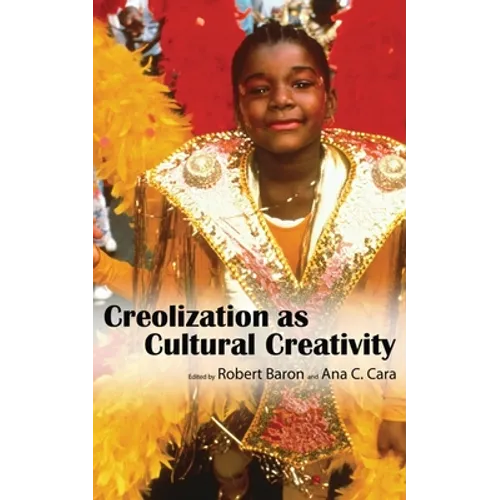
Product Description
by Robert Baron (Editor), Ana C. Cara (Editor)
What happens when cultures meet and new creative expressions emerge Global in scope and multidisciplinary in approach, Creolization as Cultural Creativity explores the expressive forms and performances that come into being when cultures encounter one another. Creolization is presented as a powerful marker of identity in the postcolonial Creole societies of Latin America, the Caribbean, and the southwest Indian Ocean region, as well as a universal process that can occur anywhere cultures come into contact. An extraordinary number of cultures from Haiti, Martinique, Guadeloupe, the southern United States, Trinidad and Tobago, Madagascar, Mauritius, Seychelles, Réunion, Puerto Rico, Argentina, Suriname, Jamaica, and Sierra Leone are discussed in these essays. Essayists address theoretical dimensions of creolization and present in-depth field studies. Topics include adaptations of the Gombe drum over the course of its migration from Jamaica to West Africa; uses of "ritual piracy" involved in the appropriation of Catholic symbols by Puerto Rican brujos; the subversion of official culture and authority through playful and combative use of "creole talk" in Argentine literature and verbal arts; the mislabeling and trivialization ("toy blindness") of objects appropriated by African Americans in the American South; the strategic use of creole techniques among storytellers within the islands of the Indian Ocean; and the creolized character of New Orleans and its music. In the introductory essay the editors address both local and universal dimensions of creolization and argue for the centrality of its expressive manifestations for creolization scholarship. Creolization as Cultural Creativity draws from the disciplines of folklore, anthropology, ethnomusicology, literary studies, history, and material culture studies. Contributors include Roger D. Abrahams, Robert Baron, Kenneth Bilby, Ana C. Cara, J. Michael Dash, Grey Gundaker, Lee Haring, Raquel Romberg, Nick Spitzer, and John F. Swzed. Robert Baron, Brooklyn, New York, directs the folk arts program of the New York State Council on the Arts. He is the coeditor, with Nick Spitzer, of Public Folklore. Folklorist Ana C. Cara, Oberlin, Ohio, is professor of Hispanic studies at Oberlin College. Her articles have appeared in Journal of American Folklore, World Literature Today, and Latin American Research Review.
Front Jacket
What happens when cultures meet and new creative expressions emerge
Author Biography
Robert Baron directs the folk arts program of the New York State Council on the Arts and has been a non-resident Fellow at the W. E. B. Du Bois Institute for African and African American Research at Harvard University. He is coeditor (with Nick Spitzer) of Public Folklore, published by University Press of Mississippi. Folklorist Ana C. Cara is professor of Hispanic studies at Oberlin College. Her articles have appeared in the Journal of American Folklore, World Literature Today, and Latin American Research Review.