


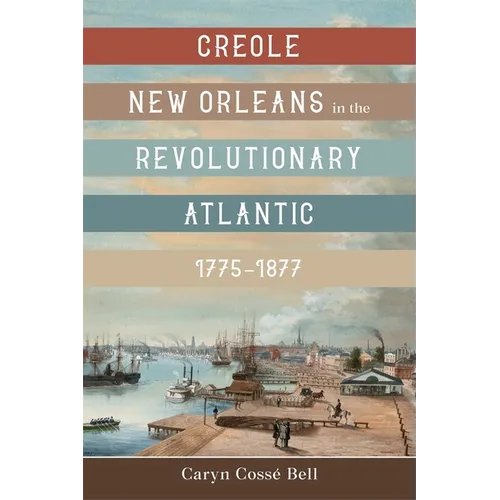
Product Description
by Caryn Cossé Bell (Author)
Nowhere in the United States did the Age of Democratic Revolution exert as profound an influence as in New Orleans. In 1809-10, refugees of the Haitian Revolution doubled the size of the city. In 1811, hundreds of Saint-Dominguan, African, and Louisianan plantation workers marched downriver toward the city in the nation's largest-ever slave revolt. Itinerant revolutionaries from throughout the Atlantic congregated in New Orleans in the cause of Latin American independence. Together with the refugee soldiers of the Haitian Revolution (both Black and white), their presence proved decisive in the Battle of New Orleans. After defeating the British, the soldiers rejoined the struggle against Spanish imperialism. In Creole New Orleans in the Revolutionary Atlantic, 1775-1877, Caryn Cossé Bell sets forth these momentous events and much more to document the revolutionary era's impact on the city.
Bell's study begins with the 1883 memoir of Hélène d'Aquin Allain, a French Creole and descendant of the refugee community, who grew up in antebellum New Orleans. Allain's d'Aquin forebears fought alongside the Savarys, a politically influential free family of color, in the Haitian Revolution. Forced from Saint-Domingue/Haiti, the allied families retreated to New Orleans. Bell's reconstruction of the d'Aquin family network, interracial alliances, and business partnerships provides a productive framework for exploring the city's presence at the crossroads of the revolutionary Atlantic. Residing in New Orleans in the heyday of French Romanticism, Allain experienced a cultural revolution that exerted an enormous influence on religious beliefs, literature, politics, and even, as Bell documents, the practice of medicine in the city. In France, the highly politicized nature of the movement culminated in the 1848 French Revolution with its abolition of slavery and enfranchisement of freed men and women. During the Civil War and Reconstruction, the Afro-Creole leaders of the diasporic community pointed to events in France and stood in the forefront of the struggle to revolutionize race relations in their own nation. As Bell demonstrates, their cultural and political legacy remains a formidable presence in twenty-first-century New Orleans.Author Biography
Caryn Cossé Bell is professor emeritus of history at the University of Massachusetts Lowell and associate scholar at the Ethel & Herman L. Midlo Center for New Orleans Studies at the University of New Orleans. She is the author of numerous books on francophone Louisiana, including Revolution, Romanticism, and the Afro-Creole Protest Tradition in Louisiana, 1718-1868.



