


Product Description
by James Sterba (Author), Richard Swinburne (Author)
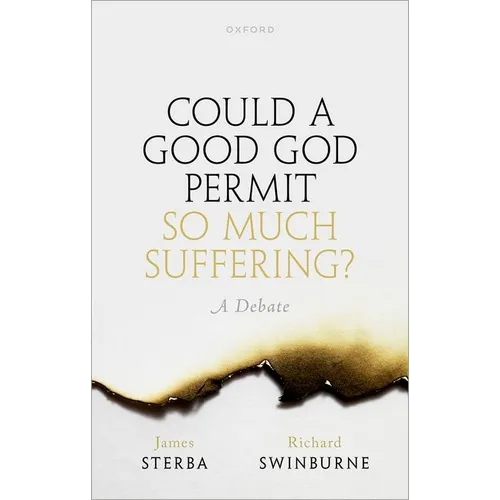
Could a Good God Permit So Much Suffering? presents a debate over whether the degree and amount of moral evil that actually exists in our world is logically incompatible with the existence of the all-good, all-powerful God of traditional theism. James Sterba puts the case in favour of this proposition, on the basis that the evils of the world are so horrendous that their occurrence violates principles requiring the prevention of moral evil, conclusively showing the non-existence of an omnipotent and perfectly good God. In reply, Richard Swinburne argues that our major benefactors, parents and the State, have rights to permit us to suffer if doing so is necessary to secure some good for ourselves or others. Therefore, Swinburne claims, as so much greater a benefactor than are parents and the State, it follows that God has a far greater right to allow suffering to a high degree if allowing such suffering is the only logically possible way for God to secure some very great goods for ourselves or others. Further responses from both Sterba and Swinburne continue the debate, ensuring that all lines of argument are thoroughly explored.
Author Biography
James Sterba, University of Notre Dame, Richard Swinburne, University of Oxford
James Sterba is Professor of Philosophy at the University of Notre Dame, where he teaches graduate and undergraduate courses in ethics and political philosophy. He has published thirty-five books and over 200 articles. In 2013, he received a grant from the John Templeton Foundation to research the relationship between ethics and the problem of evil. Richard Swinburne is a Fellow of the British Academy, and was Professor of the Philosophy of Religion at the University of Oxford from 1985 to 2002. He has written a trilogy on the meaning and justification of theism, a tetralology of books on the meaning and justification of central Christian doctrines, and books on other philosophical topics, including epistemic justification, the philosophy of mind and free will. His most recent book is Are We Bodies or Souls? (OUP, 2019). He continues to give lectures in many countries.