


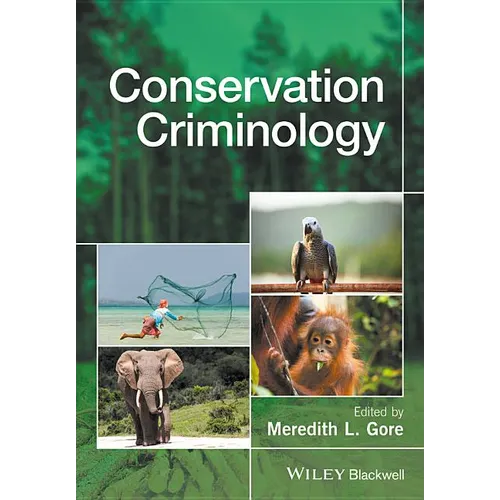
Product Description
by Meredith L. Gore (Editor)
This important new text introduces conservation criminology as the interdisciplinary study of environmental exploitation and risks at the intersection of human and natural systems. Taking an interdisciplinary approach, the book enhances understanding of the various human and organizational behaviors that pose risks to the environment, humans, and drive conservation crime. As human population growth, global market economies, climate change, deforestation, and illegal exploitation of natural resources continue to increase, academic research from numerous disciplines is needed to address these challenges.
Conservation Criminology promotes thinking about how unsustainable natural resources exploitation is a cause and a consequence of social conflict. Case studies profiled in the book demonstrate this cause and effect type situation, as well as innovative approaches for reducing risks to people and the environment. This text encourages readers to consider how humans behave in response to environmental risks and the various mechanisms that constitute effective and ineffective approaches to enforcement of wildlife crimes, including environmental and conservation policy. Case studies from the USA, Latin America, Africa, and Asia highlight corruption in conservation, global trade in electronic waste, illegal fishing, illegal logging, human-wildlife conflict, technology and space, water insecurity, wildlife disease, and wildlife poaching. Taken together, chapters expand the reader's perspective and employ tools to understand and address environmental crimes and risks, and to provide novel empirical evidence for positive change. With established contributors providing interdisciplinary and global perspectives, this book establishes a foundation for the emerging field of conservation criminology.
Back Jacket
This important new text introduces conservation criminology as the interdisciplinary study of environmental exploitation and risks at the intersection of human and natural systems. Taking an interdisciplinary approach, the book enhances understanding of the various human and organizational behaviors that pose risks to the environment, humans, and drive conservation crime. As human population growth, global market economies, climate change, deforestation, and illegal exploitation of natural resources continue to increase, academic research from numerous disciplines is needed to address these challenges.
Conservation Criminology promotes thinking about how unsustainable natural resources exploitation is a cause and a consequence of social conflict. Case studies profiled in the book demonstrate this cause and effect type situation, as well as innovative approaches for reducing risks to people and the environment. This text encourages readers to consider how humans behave in response to environmental risks and the various mechanisms that constitute effective and ineffective approaches to enforcement of wildlife crimes, including environmental and conservation policy. Case studies from the USA, Latin America, Africa, and Asia highlight corruption in conservation, global trade in electronic waste, illegal fishing, illegal logging, human-wildlife conflict, technology and space, water insecurity, wildlife disease, and wildlife poaching. Taken together, chapters expand the reader's perspective and employ tools to understand and address environmental crimes and risks, and to provide novel empirical evidence for positive change. With established contributors providing interdisciplinary and global perspectives, this book establishes a foundation for the emerging field of conservation criminology.
Author Biography
About the editor
Meredith L. Gore is a conservation social scientist whose interdisciplinary research explores relationships between human behavior and the environment. She is an Associate Professor in the Department of Fisheries & Wildlife and School of Criminal Justice at Michigan State University (MSU) and Jefferson Science Fellow with the US Department of State. Dr. Gore is a MSU Global Research Fellow and President of the Society for Conservation Biology's Social Science Working Group.



