


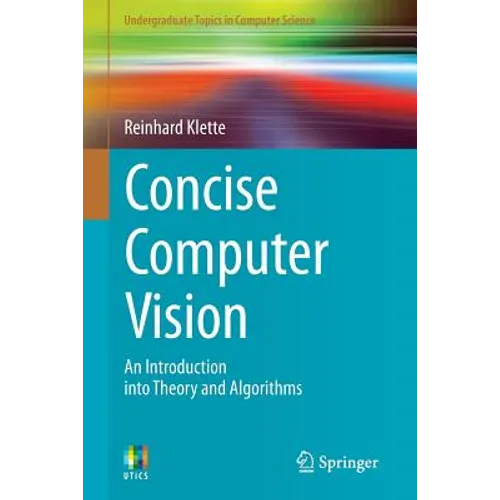
Product Description
by Reinhard Klette (Author)
Many textbooks on computer vision can be unwieldy and intimidating in their coverage of this extensive discipline. This textbook addresses the need for a concise overview of the fundamentals of this field.
Concise Computer Vision provides an accessible general introduction to the essential topics in computer vision, highlighting the role of important algorithms and mathematical concepts. Classroom-tested programming exercises and review questions are also supplied at the end of each chapter.
Topics and features: provides an introduction to the basic notation and mathematical concepts for describing an image, and the key concepts for mapping an image into an image; explains the topologic and geometric basics for analysing image regions and distributions of image values, and discusses identifying patterns in an image; introduces optic flow for representing dense motion, and such topics in sparse motion analysis as keypoint detection and descriptor definition, and feature tracking using the Kalman filter; describes special approaches for image binarization and segmentation of still images or video frames; examines the three basic components of a computer vision system, namely camera geometry and photometry, coordinate systems, and camera calibration; reviews different techniques for vision-based 3D shape reconstruction, including the use of structured lighting, stereo vision, and shading-based shape understanding; includes a discussion of stereo matchers, and the phase-congruency model for image features; presents an introduction into classification and learning, with a detailed description of basic AdaBoost and the use of random forests.
This concise and easy to read textbook/reference is ideal for an introductory course at third- or fourth-year level in an undergraduate computer science or engineering programme.
Back Jacket
Many textbooks on computer vision can be unwieldy and intimidating in their coverage of this extensive discipline. This textbook addresses the need for a concise overview of the fundamentals of this field.
Concise Computer Vision provides an accessible general introduction to the essential topics in computer vision, highlighting the role of important algorithms and mathematical concepts. Classroom-tested programming exercises and review questions are also supplied at the end of each chapter.
Topics and features:
- Provides an introduction to the basic notation and mathematical concepts for describing an image, and the key concepts for mapping an image into an image
- Explains the topologic and geometric basics for analysing image regions and distributions of image values, and discusses identifying patterns in an image
- Introduces optic flow for representing dense motion, and such topics in sparse motion analysis as keypoint detection and descriptor definition, and feature tracking using the Kalman filter
- Describes special approaches for image binarization and segmentation of still images or video frames
- Examines the three basic components of a computer vision system, namely camera geometry and photometry, coordinate systems, and camera calibration
- Reviews different techniques for vision-based 3D shape reconstruction, including the use of structured lighting, stereo vision, and shading-based shape understanding
- Includes a discussion of stereo matchers, and the phase-congruency model for image features
- Presents an introduction into classification and learning, with a detailed description of basic AdaBoost and the use of random forests
This concise and easy to read textbook/reference is ideal for an introductory course at third- or fourth-year level in an undergraduate computer science or engineering programme.
Author Biography
Dr. Reinhard Klette, FRSNZ, is a Professor at the Tamaki Innovation Campus of The University of Auckland, New Zealand. His numerous other publications include the Springer title Euclidean Shortest Paths: Exact or Approximate Algorithms.



