


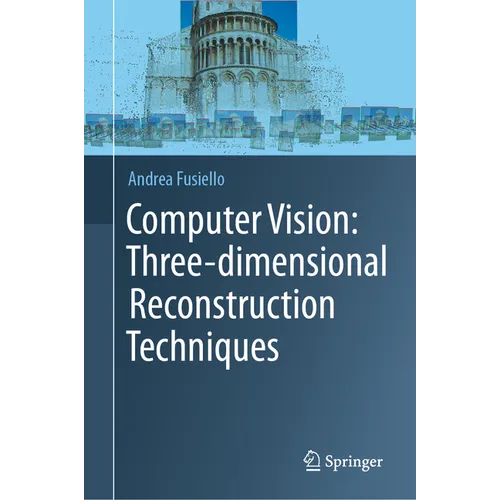
Product Description
by Andrea Fusiello (Author)
From facial recognition to self-driving cars, the applications of computer vision are vast and ever-expanding. Geometry plays a fundamental role in this discipline, providing the necessary mathematical framework to understand the underlying principles of how we perceive and interpret visual information in the world around us.
This text explores the theories and computational techniques used to determine the geometric properties of solid objects through images. It covers the basic concepts and provides the necessary mathematical background for more advanced studies. The book is divided into clear and concise chapters covering a wide range of topics including image formation, camera models, feature detection and 3D reconstruction. Each chapter includes detailed explanations of the theory as well as practical examples to help the reader understand and apply the concepts presented.
The book has been written with the intention of being used as a primary resource for students on university courses in computer vision, particularly final year undergraduate or postgraduate computer science or engineering courses. It is also useful for self-study and for those who, outside the academic field, find themselves applying computer vision to solve practical problems. The aim of the book is to strike a balance between the complexity of the theory and its practical applicability in terms of implementation. Rather than providing a comprehensive overview of the current state of the art, it offers a selection of specific methods with enough detail to enable the reader to implement them.Back Jacket
From facial recognition to self-driving cars, the applications of computer vision are vast and ever-expanding. Geometry plays a fundamental role in this discipline, providing the necessary mathematical framework to understand the underlying principles of how we perceive and interpret visual information in the world around us.
This text explores the theories and computational techniques used to determine the geometric properties of solid objects through images. It covers the basic concepts and provides the necessary mathematical background for more advanced studies. The book is divided into clear and concise chapters covering a wide range of topics including image formation, camera models, feature detection and 3D reconstruction. Each chapter includes detailed explanations of the theory as well as practical examples to help the reader understand and apply the concepts presented.
The book has been written with the intention of being used as a primary resource for students on university courses in computer vision, particularly final year undergraduate or postgraduate computer science or engineering courses. It is also useful for self-study and for those who, outside the academic field, find themselves applying computer vision to solve practical problems. The aim of the book is to strike a balance between the complexity of the theory and its practical applicability in terms of implementation. Rather than providing a comprehensive overview of the current state of the art, it offers a selection of specific methods with enough detail to enable the reader to implement them.Author Biography
Andrea Fusiello has been teaching computer vision since 2000, first at the University of Verona and then at the University of Udine, where he is currently Professor of Computer Science. He has published more than 180 papers on these topics, and in 2011 he co-founded a start-up company that applies computer vision in the field.