


Product Description
by Stuart S. Nagel (Author)
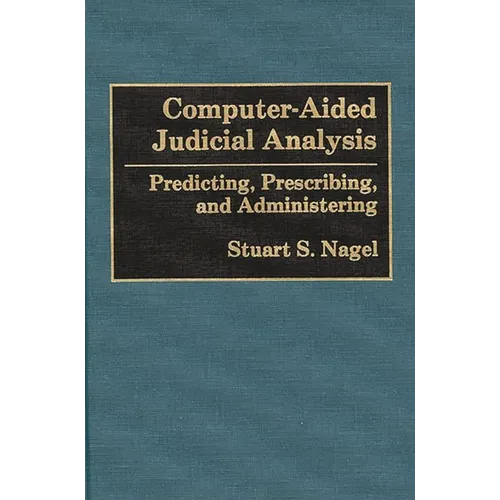
Decision-aiding software, the underpinning of computer-aided judicial analysis, can facilitate the prediction of how cases are likely to be decided, prescribe decisions that should be reached in such cases, and help administrate more efficiently the court process. It can do so, says Nagel, by listing past cases on each row of a spreadsheet matrix, by listing predictive criteria in the columns, and in general by showing for each factual element the estimated probability of winning a case. The software aggregates the information available and deduces likely outcomes. But it can also prescribe judicial decisions by listing alternatives in the rows, the goals to be achieved in the columns, and by showing relations between alternatives in the cells. By similar means decision-aiding software can also help perform administrative tasks, such as rationally assigning judges or other personnel to cases, and by sequencing cases to reduce the time consumed by each case.
In Part I, Nagel provides an overview of computer-aided analysis and the role of decision-aiding software in the legal process. In the second part he deals with judicial prediction from prior cases and from present facts; and in the third part he emphasizes the prescribing role of judges, particularly in deciding the rules that ought to be applied in civil and criminal procedures. Nagel also covers computer-aided mediation and provides a new perspective on judicial decisions. Then, in Part IV, he treats at length the process of judicial administration and how to improve its efficiency. Of particular interest to court personnel will be the benefits to be derived from reducing delays and in the docketing and sequencing of cases.Author Biography
STUART S. NAGEL is Professor of Political Science at the University of Illinois and a member of the Illinois bar. He is the author of such relevant books as Decision-Aiding Software and Legal Decision-Making: A Guide to Skills and Applications throughout the Law (Quorum Books, 1990). He is the editor of such relevant books as Law, Decision-Making, and Microcomputers: Cross-National Perspectives (Quorum Books, 1991), and Public Administration and Decision-Aiding Software: Improving Procedure and Substance (Greenwood Press, 1990). He has been an attorney to the United States Senate Judiciary Committee, the National Labor Relations Board, and the Legal Services Corporation. He has also been a special master to the Federal District Courts. He is also active as a workshop instructor for courses sponsored by the ABA Judicial Administrative Division and the American Law Institute.