


Product Description
by Peter J. Morin (Author)
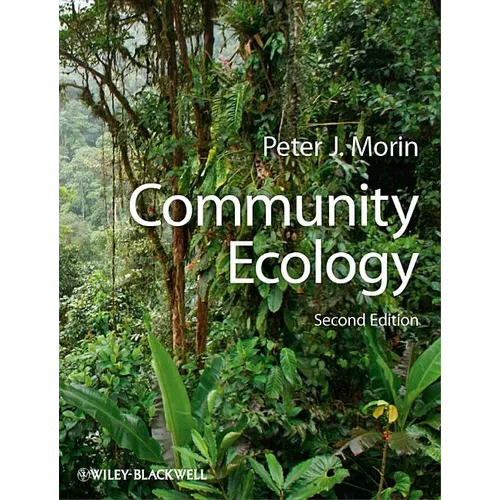
All life on earth occurs in natural assemblages called communities. Community ecology is the study of patterns and processes involving these collections of two or more species. Communities are typically studied using a diversity of techniques, including observations of natural history, statistical descriptions of natural patterns, laboratory and field experiments, and mathematical modelling. Community patterns arise from a complex assortment of processes including competition, predation, mutualism, indirect effects, habitat selection, which result in the most complex biological entities on earth - including iconic systems such as rain forests and coral reefs.
This book introduces the reader to a balanced coverage of concepts and theories central to community ecology, using examples drawn from terrestrial, freshwater, and marine systems, and focusing on animal, plant, and microbial species. The historical development of key concepts is described using descriptions of classic studies, while examples of exciting new developments in recent studies are used to point toward future advances in our understanding of community organization. Throughout, there is an emphasis on the crucial interplay between observations, experiments, and mathematical models.
This second updated edition is a valuable resource for advanced undergraduates, graduate students, and established scientists who seek a broad overview of community ecology. The book has developed from a course in community ecology that has been taught by the author since 1983.
Figures and tables can be downloaded for free from www.wiley.com/go/morin/communityecology
Back Jacket
All life on earth occurs in natural assemblages called communities. Community ecology is the study of patterns and processes involving these collections of two or more species. Communities are typically studied using a diversity of techniques, including observations of natural history, statistical descriptions of natural patterns, laboratory and field experiments, and mathematical modelling. Community patterns arise from a complex assortment of processes including competition, predation, mutualism, indirect effects, habitat selection, which result in the most complex biological entities on earth - including iconic systems such as rain forests and coral reefs.
This book introduces the reader to a balanced coverage of concepts and theories central to community ecology, using examples drawn from terrestrial, freshwater, and marine systems, and focusing on animal, plant, and microbial species. The historical development of key concepts is described using descriptions of classic studies, while examples of exciting new developments in recent studies are used to point toward future advances in our understanding of community organization. Throughout, there is an emphasis on the crucial interplay between observations, experiments, and mathematical models.
This second updated edition is a valuable resource for advanced undergraduates, graduate students, and established scientists who seek a broad overview of community ecology. The book has developed from a course in community ecology that has been taught by the author since 1983.
Author Biography
Peter Morin is a leading experimental community ecologist. He is interested in many aspects of community ecology, including predator-prey interactions, food webs, and the causes and consequences of biological diversity.


