


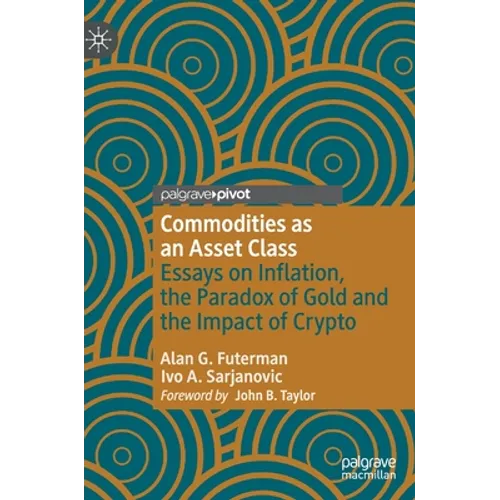
Product Description
by Alan G. Futerman (Author), Ivo A. Sarjanovic (Author)
This book challenges the notion that commodities are always good hedges against inflation, which is the conventional belief today in financial markets. Specifically, it focuses on gold as a traditional hedge and the ways in which crypto assets are argued to be positioned as an alternative hedge against inflationary risk.
The book engages with emerging debates around the performance of gold since the 2008 financial crisis, analyzing its characteristics, relationship with inflation, and the role of mining companies, and discusses ways that cryptocurrencies have replaced precious metals as an attractive asset class during an inflationary scenario. In considering the case of crypto as being or not a good inflation hedge, the book devotes particular attention to the theoretical financial and macroeconomic implications of a monetary system based on Bitcoin, dealing with the concept of money and the determination of Bitcoin's supply and purchasing power. Additionally, it outlines the consequences that such a system would entail for the banking industry, and financial conditions involving interest rates, exchange rates, and the inflation-deflation dynamic. The book also analyses the relative impact of past and future events on the different commodity families.
This work will be of interest to students and researchers in financial economics, macroeconomics, and monetary economics, as well as analysts and traders in financial and commodity markets.Back Jacket
This book challenges the notion that commodities are always good hedges against inflation, which is the conventional belief today in financial markets. Specifically, it focuses on gold as a traditional hedge and the ways in which crypto assets are argued to be positioned as an alternative hedge against inflationary risk.
The book engages with emerging debates around the performance of gold since the 2008 financial crisis, analyzing its characteristics, relationship with inflation, and the role of mining companies, and discusses ways that cryptocurrencies have replaced precious metals as an attractive asset class during an inflationary scenario. In considering the case of crypto as being or not a good inflation hedge, the book devotes particular attention to the theoretical financial and macroeconomic implications of a monetary system based on Bitcoin, dealing with the concept of money and the determination of Bitcoin's supply and purchasing power. Additionally, it outlines the consequences that such a system would entail for the banking industry, and financial conditions involving interest rates, exchange rates, and the inflation-deflation dynamic. The book also analyses the relative impact of past and future events on the different commodity families.
Alan Futerman is Adjunct Professor of Institutional Economics at the University of the Latin American Educational Center (Rosario, Argentina). He is co-author of The Classical Liberal Case for Israel and The Austro-Libertarian Point of View (Springer, 2021) and has published in journals such as International Journal of Finance & Economics.
Ivo Sarjanovic is Professor of Agricultural Commodites at the Di Tella University and Lecturer on "Soft Commodities" at the University of Geneva. He is currently independent director of several companies in the industry. He was Vice President of Cargill Switzerland and CEO of Alvean and he has more than 30 years of experience in commodity trading.
Author Biography
Alan Futerman is Adjunct Professor of Institutional Economics at the University of the Latin American Educational Center (Rosario, Argentina). He is co-author of The Classical Liberal Case for Israel and The Austro-Libertarian Point of View (Springer, 2021) and has published in journals such as International Journal of Finance & Economics.
Ivo Sarjanovic is Professor of Agricultural Commodites at the Di Tella University and Lecturer on "Soft Commodities" at the University of Geneva. He is currently independent director of several companies in the industry. He was Vice President of Cargill Switzerland and CEO of Alvean and he has more than 30 years of experience in commodity trading.


