Skip to content
Welcome To Our Store.
100,000+ Products for Home, Medical, Office & Classroom Needs
Search
Skip to product information
1 of 1

Colonialism and Postcolonial Development: Spanish America in Comparative Perspective - Paperback

$56.61 USD
$56.61 USD
Sale Sold out
Shipping calculated at checkout.
In stock (100 units), ready to be shipped

Available Offers

Fast delivery available on most orders

Multiple secure payment options accepted

Secure checkout with
  • American Express
  • Apple Pay
  • Diners Club
  • Discover
  • Google Pay
  • Mastercard
  • PayPal
  • Shop Pay
  • Visa

Flight Range: Up to 1,000 meters (3,280 feet)

Maximum Speed: 45 kilometers per hour (28 miles per hour)

For all orders exceeding a value of 100USD shipping is offered for free.

Returns will be accepted for up to 10 days of Customer’s receipt or tracking number on unworn items. You, as a Customer, are obliged to inform us via email before you return the item.

Otherwise, standard shipping charges apply. Check out our delivery Terms & Conditions for more details.

View Product Details
Shopping cart
Product Product subtotal Quantity Price Product subtotal
Colonialism and Postcolonial Development: Spanish America in Comparative Perspective - Paperback
$56.61/ea
$0.00
$56.61/ea $0.00

Product Description

by James Mahoney (Author)

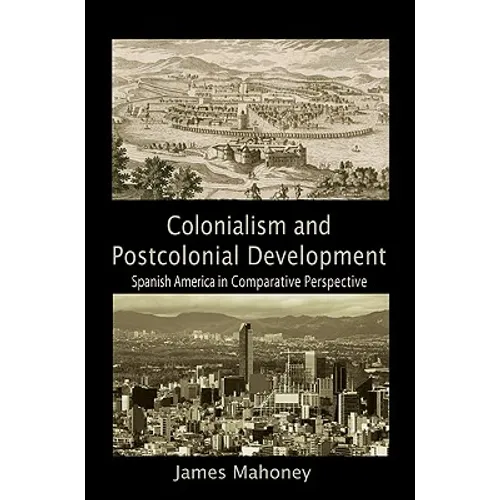
In this comparative-historical analysis of Spanish America, James Mahoney offers a new theory of colonialism and postcolonial development. The book explores why certain kinds of societies are subject to certain kinds of colonialism and why these forms of colonialism give rise to countries with differing levels of economic prosperity and social well-being. Mahoney contends that differences in the extent of colonialism are best explained by the potentially evolving fit between the institutions of the colonizing nation and those of the colonized society. Moreover, he shows how institutions forged under colonialism bring countries to relative levels of development that may prove remarkably enduring in the postcolonial period. The argument is sure to stir discussion and debate, both among experts on Spanish America who believe that development is not tightly bound by the colonial past, and among scholars of colonialism who suggest that the institutional identity of the colonizing nation is of little consequence.


Number of Pages: 424
Dimensions: 0.9 x 9.1 x 6.2 IN
Illustrated: Yes
Publication Date: February 15, 2010
you might like
