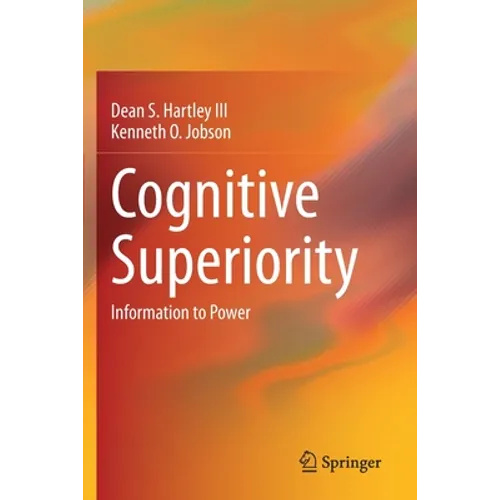
Product Description
by Dean S. Hartley III (Author), Kenneth O. Jobson (Author)
In a world of accelerating unending change, perpetual surveillance, and increasing connectivity, conflict has become ever more complex. Wars are no longer limited to the traditional military conflict domains--land, sea, air; even space and cyber space. The new battlefield will be the cognitive domain and the new conflict a larger contest for power; a contest for cognitive superiority. Written by experts in military operations research and neuropsychology, this book introduces the concept of cognitive superiority and provides the keys to succeeding within a complex matrix where the only rules are the laws of physics, access to information, and the boundaries of cognition.
The book describes the adversarial environment and how it interacts with the ongoing, accelerating change that we are experiencing, irrespective of adversaries. It talks about the ascendant power of information access, pervasive surveillance, personalized persuasion, and emerging new forms of cognition. It profiles salient technologies and science, including persuasion science, artificial intelligence and machine learning (AI/ML), surveillance technologies, complex adaptive systems, network science, directed human modification, and biosecurity. Readers will learn about human and machine cognition, what makes it tick, and why and how we and our technologies are vulnerable.
Following in the tradition of Sun-Tsu and von Clausewitz, this book writes a new chapter in the study of warfare and strategy. It is written for those who lead, aspire to leadership, and those who teach or persuade, especially in the fields of political science, military science, computer science, and business.
Back Jacket
In a world of accelerating unending change, perpetual surveillance, and increasing connectivity, conflict has become ever more complex. Wars are no longer limited to the traditional military conflict domains--land, sea, air; even space and cyber space. The new battlefield will be the cognitive domain and the new conflict a larger contest for power; a contest for cognitive superiority. Written by experts in military operations research and neuropsychology, this book introduces the concept of cognitive superiority and provides the keys to succeeding within a complex matrix where the only rules are the laws of physics, access to information, and the boundaries of cognition.
The book describes the adversarial environment and how it interacts with the ongoing, accelerating change that we are experiencing, irrespective of adversaries. It talks about the ascendant power of information access, pervasive surveillance, personalized persuasion, and emerging new forms of cognition. It profiles salient technologies and science, including persuasion science, artificial intelligence and machine learning (AI/ML), surveillance technologies, complex adaptive systems, network science, directed human modification, and biosecurity. Readers will learn about human and machine cognition, what makes it tick, and why and how we and our technologies are vulnerable.
Following in the tradition of Sun-Tsu and von Clausewitz, this book writes a new chapter in the study of warfare and strategy. It is written for those who lead, aspire to leadership, and those who teach or persuade, especially in the fields of political science, military science, computer science, and business.
Author Biography
Dr. Dean S. Hartley III is the Principal of Hartley Consulting. He received his Ph.D. in piecewise linear topology from the University of Georgia in 1973. He is a Director of the Military Operations Research Society (MORS), past Vice President of the Institute for Operations Research and Management Science (INFORMS), and past President of the Military Applications Society (MAS). He is the author of Predicting Combat Effects, Unconventional Conflict: A Modeling Perspective, An Ontology for Unconventional Conflict, and An Ontology of Modern Conflict: Including Conventional Combat and Unconventional Conflict. Hartley's interests include modeling of irregular warfare (IW), verification and validation of models, general modeling, simulation, and psychopharmacology.
Dr. Kenneth O. Jobson, M.D. founded and developed the National Psychopharmacology Laboratory (NPL). He was on the clinical faculty at the University of Tennessee, Department of Psychiatry, and co-edited a textbook, Textbook of Treatment Algorithms in Psychopharmacology. He is the founder and chairman of the board of the International Psychopharmacology Algorithm Project (www.ipap.org), which has been recognized by the World Health Organization (WHO). He has facilitated the establishment of algorithm projects in the United States, Europe and Asia.