Product Description
by Kristofer Ray (Author)
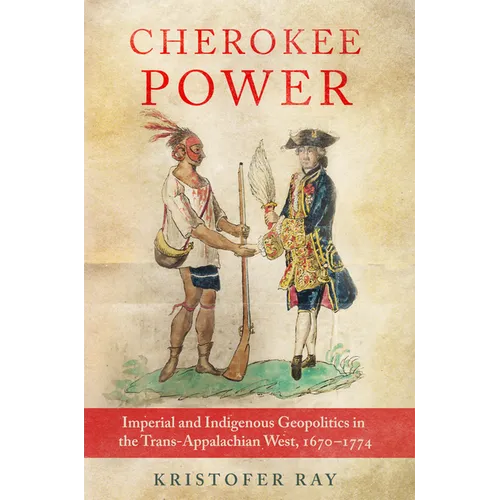
In 1754 South Carolina governor James Glen observed that the Tennessee River "has its rise in the Cherokee Nation and runs a great way through it." While noting the "prodigious" extent of the corridor connecting the Tennessee, Ohio, and Wabash River valleys-and the Cherokees' "undoubted" ownership of this watershed-Glen and other European observers were much less clear about the ambitions and claims of European empires and other Indigenous polities regarding the North American interior. In Cherokee Power, Kristofer Ray brings long-overdue clarity to this question by highlighting the role of the Overhill Cherokees in shaping imperial and Indigenous geopolitics in seventeenth- and eighteenth-century America.
As Great Britain and France eyed the Illinois country and the Tennessee, Ohio, and Wabash River valleys for their respective empires, the Overhill Cherokees were coalescing and maintaining a conspicuous presence throughout the territory. Contrary to the traditional narrative of westward expansion, the Europeans were not the drivers behind the ensuing contest over the Tennessee corridor. The Overhills traded, negotiated, and fought with other Indigenous peoples along this corridor, in the process setting parameters for European expansion. Through the eighteenth century, the British and French struggled to overcome a dissonance between their visions of empire and the reality of Overhill mobility and sovereignty-a struggle that came to play a crucial role in the Anglo-American revolutionary debate that dominated the 1760s and 1770s.
By emphasizing Indigenous agency in this rapidly changing world, Cherokee Power challenges long-standing ideas about the power and reach of European empires in eighteenth-century North America.