Product Description
by Jeff Bowen (Transcribed by)
The Cherokee relied upon their leaders to guide them but they ended up hanging in the balance after the Civil War. Fathers and brothers were off fighting a war that didn't even concern them. The men fighting the war came back to the same old political hatreds and in-fighting. The Nation was being overrun with many that claimed they were Cherokee, hoping to benefit from false claims of citizenship. These people, known as intruders, did nothing but make it more difficult for the Cherokees because of the pressures from the Government to control their boundaries. Intruder after intruder was encroaching on Cherokee land. Many Cherokee citizens had lost their rights while intruders that didn't belong stayed using up what little resources there were. The government was telling the Cherokee leaders to settle their own intruder problems or else they would have to intercede. There were part-bloods, full-bloods, and no bloods along with mass confusion, prejudice, vendettas, and deceptions. The intruders wanted a free ride and were willing to use the confusion as a camouflage to achieve their purpose and greed. This was a situation where the government was threatening to come in and turn the Cherokee Nation into a Federal Territory. Ever since 1872, federal agents had refused to expel from the Nation those former slaves whom the Nation considered 'aliens' and since 1874, federal agents had been under instructions from the Bureau of Indian Affairs to compile their own list of persons in their opinion, had some claim to citizenship despite previous rulings of the Cherokee Courts on their claims. The Cherokee Chief Oochalata claiming that a government agent was meddling in Cherokee affairs and wrote to the Bureau of Indian Affairs to complain. Writing a letter to President Grant and sending a petition from one of the Cherokee districts he complained that the agent had not removed thousands of intruders. By the end of 1878, Oochalata struggling to solve the problem gain went over the head of the Bureau of Indian Affairs and wrote to President Rutherford B. Hayes forwarding a complete account of all cases adjudicated by the Citizenship Court. Finally, presenting three questions to the Attorney General at the time, Charles Devens, to answer were: Did the Cherokee Nation have the right to determine its own citizenship? Did the former slaves who were citizens have any share in the use of Cherokee land or in the money derived from the sale of Cherokee land? Was it, or was it not, the duty of the Federal Government to remove intruders under treaty stipulations? Devens' opinion was clearly in the negative as far as the Cherokee Nation's sovereignty and decision processes were concerned. Since the days of Andrew Jackson refusal to honor the requirement of removing intruders was to be the means of forcing the Indian nations to do what they did not want to do.
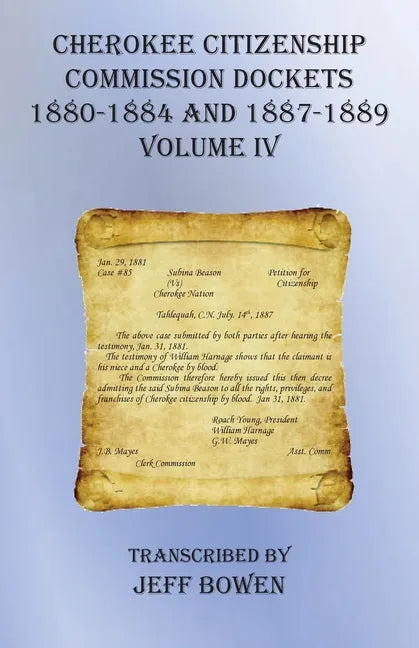
This series contains documentation from the rulings of the Cherokee Citizenship Commission dockets. Besides the names of the applicant and the presiding commissioners and the date of the determination, the transcriptions mostly identify the names of family members and their relationship to the person(s) filing the application. In all, researchers will find references to approximately 20,000 Cherokee claimants in this series.