Product Description
by Hugh Harkins (Author)
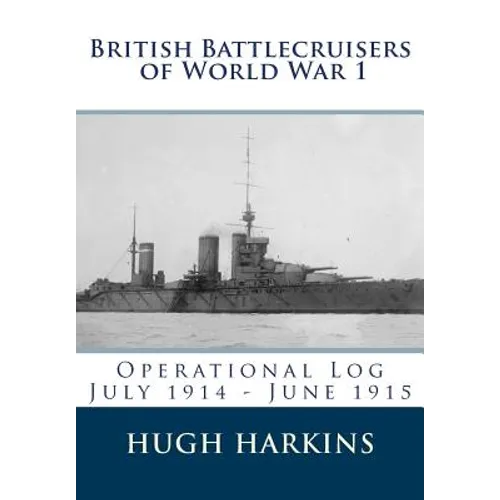
The purpose of this volume is to provide a detailed log of the operations of the Royal Navy Battle Cruisers and associated units from July 1914 until the end of June 1915. During this time the Battle Cruisers were engaged with elements of the German Fleet on a number of occasions; most notably in the Battle of the Heligoland Bight in August 1914, The Battle of the Falkland Islands in December 1914 and the Battle of the Dogger Bank in January 1915. In only the Dogger Bank action did the opposing forces Battle Cruisers engage in battle which resulted in a material and strategic defeat for the German High Seas Fleet, albeit at the cost on one British Battle Cruiser severely damaged. In the Heligoland Bight action on 28 August 1914, the British Battle Cruisers provided support to light forces engaging German Light forces. The result was a defeat for the German Fleet, which now concentrated in strengthening the defenses of the area. The Battle of the Falkland Islands in December 1914 was a pivotal moment for the advocates of the Battle Cruiser concept. It successfully engaged and defeated enemy Armoured Cruisers, and Light Cruisers; the very role for which it had been designed. Intended as an operational history of the employment of the British Battle Cruisers, it is not the intention of this volume to go into the details of the rights or wrongs of the Battle Cruiser concept. It will suffice for the purposes of this volume to state that the designs emerged as an evolution or replacement of the Armoured Cruiser. Not tied to any single role, the new Battle Cruiser was capable of operating as independent units hunting down enemy Cruisers, as in the Falklands battle, or in larger scale operations with the Battle Fleet; scouting ahead with the potential to operate as a fast wing of the Battle Fleet in a fleet action. For this latter role, later in the war the British Battle Cruisers in particular proved unsound in design, tactics or a combination of both. During the first year of the War British Battle Cruisers would be employed in all of the above roles.