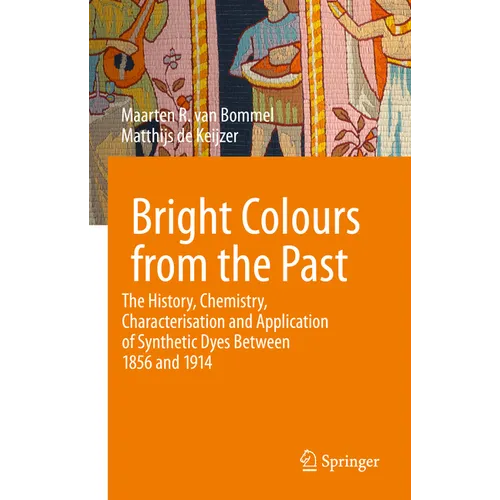
Product Description
by Maarten R. Van Bommel (Author), Matthijs De Keijzer (Author)
The invention of Mauveine by Perkin in 1856 led to a revolution in the world of textile
dyeing. In the second half of the 19th century, natural dyes were quickly replaced by newly developed synthetic dyes which resulted in a bright palette of colours. The synthetic dyes were not only cheaper to produce, but also easier to apply on textiles due to new dyeing mechanisms. As a result, production costs decreased tremendously and brilliantly dyed textiles became available to the larger public. The introduction of synthetic dyes had a strong impact in fashion; in addition, these colourants were also used as stains on furniture, as inks and in paints. In this publication, the development of these vivid colourants is presented. It brings together information about the history of synthetic dyes, including the first attempts, the so-called semi-synthetic dyes, and presenting the most relevant dyes and dye classes, such as nitro dyes, tri-arylmethanes, azo dyes, xanthenes, sulfur dyes, synthetic alizarin and synthetic indigo. It contains a wealth of information regarding the numerous synonyms, trade names, manufacturers and patents. International trade and competition, which was fierce, are discussed. The chemistry behind the synthetic dyeing is explained, including new dyeing technologies developed. The application of dyes and their fastness properties are also presented. An overview of analytical techniques used for characterisation is given. Many case studies are included, expressing the importance of the dyes and the creativity of mankind when applying these colourants. As such, this publication can be seen as a colourful journey through history, relevant for conservators, curators, historians, chemists and all who are interested in the history and development of synthetic dyes.Back Jacket
The invention of Mauveine by Perkin in 1856, led to a revolution in the world of textile dyeing. In the second half of the 19th century, natural dyes were quickly replaced by newly developed synthetic dyes which resulted in a bright palette of colours. The synthetics dyes were not only cheaper to produce, but also easier to apply on textiles due to new dyeing mechanisms. As a result, production costs decreased tremendously and brilliantly dyed textiles became available to the larger public. The introduction of synthetic dyes had a strong impact in fashion, in addition, these colourant were also used as stains on furniture, as inks and in paints.
In this publication, the developments of these vivid colourants will be presented. It will bring together information about the history of synthetic dyes, including the first attempts of the so-called semi-synthetic dyes, presenting the most relevant dyes and dye classes, such as nitro dyes, tri-arylmethanes, azo dyes, xanthenes, sulfur dyes, synthetic alizarin and synthetic indigo. It contains a wealth of information regarding the numerous synonyms, trade names, manufacturers and patents. International trade and competition, which was fierce, will be discussed. The chemistry behind the synthetic dyeing will be explained, including new dyeing technologies developed. The application of dyes and their fastness properties will be presented as well. An overview of analytical techniques used for characterisation will be given. In the publication, many case studies will be presented, expressing the importance of the dyes and the creativity of mankind when applying these colourant.
As such, this publication can be seen as a colourful journey to history relevant for conservators, curators, (art) historians, chemists and all who are interested in the history and development of synthetic dyes.
Author Biography
Prof. van Bommel (1968) is full professor of conservation science at the University of Amsterdam (UvA), Faculty of Humanities, Amsterdam school of Heritage, Memory and Material Culture (AHM), Conservation and Restoration of Cultural Heritage (C&R) and at the Faculty of Science, Van 't Hoff Institute for Molecular Sciences (HIMS), Analytical Chemistry. From this unique position at two faculties, he bridges science and conservation. Before this appointment, he worked as (senior) scientist and program manager at the Netherlands institute for cultural heritage.
Van Bommel's main research focus is on material change of a wide range of heritage objects (paintings, furniture, plastics, paper, textiles, metal, glass & ceramics) with a special attention to natural and synthetic dyes. He investigates chemical composition and material change, aiming to understand the original appearance of heritage objects, and to develop mitigation and preservation strategies for cultural heritage display, management and conservation. This involves the use of advanced analytical methods, studying historical sources as a basis for model systems and historically informed reconstructions, and the development of visualisation techniques to show the presumed original appearance of objects of art. Common ground in all his projects is the development and application of a wide variety of analytical techniques to characterise material changes and understand degradation mechanisms. He has been awarded several national and international funded projects and published over 125 peer-reviewed papers, chapters, books and conference papers in both science and cultural heritage journals, and has contributed to museum catalogues and popular science publications. Ing. Matthijs de Keijzer (1952) worked as a senior conservation scientist at the Heritage Laboratory of the Cultural Heritage Agency of the Netherlands in Amsterdam. Following a successful career in analytical chemistry in various industries, he turned his attention to the study of works of art. Working in interdisciplinary teams, his research interest is the microscopic and microchemical analysis of pigments on various cultural heritage objects to solve conservation and restoration problems. In the last decade of the 20th century his research was focussed on the history of the modern pigments of that era. Since 2003, he is involved in the project ´Early Synthetic Organic Dyes´. This project is based on a selection of well-known synthetic organic dyes, covering all dye classes and is focused on the period 1856-1914. His contribution in this project was to collect information by studying the original historical literature sources, including the international patent literature. He is an expert on early and modern synthetic pigments and dyes and their use in various techniques and has published and lectured widely in these fields. He lectured at the University of Applied Arts Vienna, the University of Amsterdam, the George Enescu National University of Arts in Iasi and the University of Gothenburg. He is also co-author of the book Pigmenten en Bindmiddelen (Pigments and Binding media).