


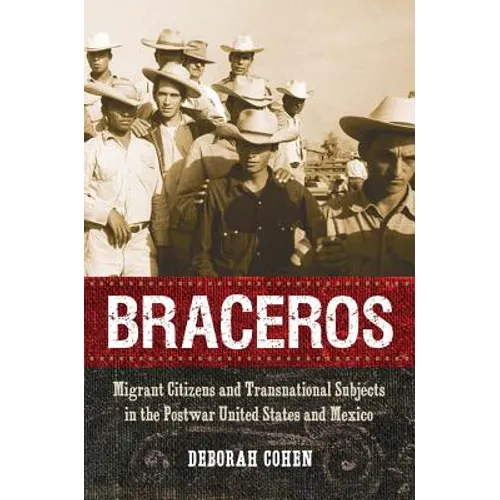
Product Description
by Deborah Cohen (Author)
At the beginning of World War II, the United States and Mexico launched the bracero program, a series of labor agreements that brought Mexican men to work temporarily in U.S. agricultural fields. In Braceros, historian Deborah Cohen asks why these temporary migrants provoked so much concern and anxiety in the United States and what the Mexican government expected to gain in participating in the program. Cohen reveals the fashioning of a U.S.-Mexican transnational world, a world created through the interactions, negotiations, and struggles of the program's principal protagonists including Mexican and U.S. state actors, labor activists, growers, and bracero migrants. Cohen argues that braceros became racialized foreigners, Mexican citizens, workers, and transnational subjects as they moved between U.S. and Mexican national spaces.
Drawing on oral histories, ethnographic fieldwork, and documentary evidence, Cohen creatively links the often unconnected themes of exploitation, development, the rise of consumer cultures, and gendered class and race formation to show why those with connections beyond the nation have historically provoked suspicion, anxiety, and retaliatory political policies.
Front Jacket
At the beginning of World War II, the United States and Mexico launched the bracero program, a series of labor agreements that brought Mexican men to work temporarily in U.S. agricultural fields. In "Braceros," historian Deborah Cohen asks why these migrants provoked so much concern and anxiety in the United States and what the Mexican government expected to gain in participating in the program. Cohen creatively links the often unconnected themes of exploitation, development, the rise of consumer cultures, and gendered class and race formation to show why those with connections beyond the nation have historically provoked suspicion, anxiety, and retaliatory political policies.



