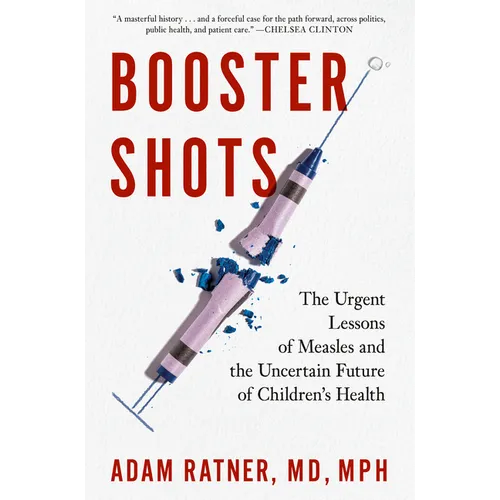
Product Description
by Adam Ratner (Author)
A pediatrician and infectious disease specialist warns of the resurgence of measles, the antivaccine movement, and how we can prepare for the next pandemic
Every single child diagnosed with measles represents a system failure--an inexcusable unforced error. The technology to prevent essentially 100 percent of measles cases has been in our hands since before the moon landing. But this serious airborne disease, once seemingly defeated, is resurgent around the globe. Why, at a time when biomedical science is so advanced, do parents turn away from vaccination, endangering their own children and the health of the wider population?Using a combination of patient narrative, historical analysis, and scientific research, Dr. Adam Ratner, pediatrician and infectious disease specialist, argues that the reawakening of measles and the subsequent coronavirus pandemic are bellwethers of forgotten knowledge--indicators of decaying trust in science and an underfunded public health infrastructure. Our collective amnesia is starkly revealed in the growth of the antivaccine movement and the missteps in our responses to the beginning of the coronavirus outbreak, leading to preventable tragedies in both cases.
Trust in medicine and public health is at a nadir. Declining vaccine confidence threatens a global reemergence of other vaccine-preventable diseases in the coming years. Ratner details how solving these problems requires the use of literal and figurative "booster shots" to gather new knowledge and retain the crucial lessons of the past. Learning--and remembering--these lessons is our best hope for preparing for the next pandemic. With attention and care and the tools we already have, we can make the world much safer for children tomorrow than it is today.
Author Biography
Adam Ratner, MD, MPH, is a professor of pediatrics and microbiology at NYU Grossman School of Medicine and the director of the Division of Pediatric Infectious Diseases at Hassenfeld Children's Hospital and Bellevue Hospital Center. In addition to practicing medicine, Dr. Ratner directs an active research group and teaches students, residents, and other trainees. He speaks widely in both academic settings and news outlets on topics relevant to vaccination and infections in childhood. His work has appeared in The New England Journal of Medicine, PNAS, Pediatrics, and other venues. He edits a major textbook of pediatric infectious diseases, has chaired grant review panels for the National Institutes of Health, and serves on numerous advisory and editorial boards.