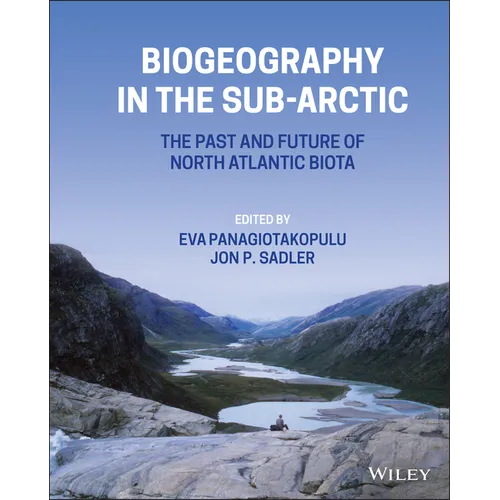
Product Description
by Eva Panagiotakopulu (Author)
There is no escaping the fact that the island biogeography of the North Atlantic Region is singularly peculiar. Sitting in the north of the Atlantic Ocean, these islands have been subjected to largescale shifts in climate over the last few million years, unlike the other island groups further south which were likely more buffered from the vicissitudes of Quaternary climate changes. Uniquely for a group of islands there is only one documented extinction in the North Atlantic (the Great Auk), and those in the insects are local events relating to species that are distributed throughout the Palaearctic region. Over half the insect species in Iceland and Greenland are introduced. The faunas, excluding Greenland, are predominantly of Palaearctic origin and have close affinities with the faunas of Scandinavia and the British Isles and. These unique physical and biological characteristics have interested biologists and biogeographers for centuries.
The key debates concerning the biogeography of the North Atlantic islands still rumble on: Do the biota reflect cryptic refugia or otherwise, or tabula rasa and recolonization? How important were human communities in shaping the existing biota and biogeographical patterns? Throw into this mix current concerns over global warming, and we can now ask, how resilient is the biota to change, either natural or anthropogenic? This volume draws together a range of researchers with longstanding research interests in the region, from diverse academic backgrounds, to evaluate some of these questions.
Front Jacket
Biogeography in the Sub-Arctic: The Past and Future of North Atlantic Biota
There is no escaping the fact that the island biogeography of the North Atlantic Region is singularly peculiar. Sitting in the north of the Atlantic Ocean, these islands have been subjected to largescale shifts in climate over the last few million years, unlike the other island groups further south which were likely more buffered from the vicissitudes of Quaternary climate changes. Uniquely for a group of islands there is only one documented extinction in the North Atlantic (the Great Auk), and those in the insects are local events relating to species that are distributed throughout the Palaearctic region. Over half the insect species in Iceland and Greenland are introduced. The faunas, excluding Greenland, are predominantly of Palaearctic origin and have close affinities with the faunas of Scandinavia and the British Isles. These unique physical and biological characteristics have interested biologists and biogeographers for centuries.
The key debates concerning the biogeography of the North Atlantic islands still rumble on: Do the biota reflect cryptic refugia or otherwise, or tabula rasa and recolonization? How important were human communities in shaping the existing biota and biogeographical patterns? Throw into this mix current concerns over global warming, and we can now ask, how resilient is the biota to change, either natural or anthropogenic? This volume draws together a range of researchers with longstanding research interests in the region, from diverse academic backgrounds, to evaluate some of these questions.
Back Jacket
Biogeography in the Sub-Arctic: The Past and Future of North Atlantic Biota
There is no escaping the fact that the island biogeography of the North Atlantic Region is singularly peculiar. Sitting in the north of the Atlantic Ocean, these islands have been subjected to largescale shifts in climate over the last few million years, unlike the other island groups further south which were likely more buffered from the vicissitudes of Quaternary climate changes. Uniquely for a group of islands there is only one documented extinction in the North Atlantic (the Great Auk), and those in the insects are local events relating to species that are distributed throughout the Palaearctic region. Over half the insect species in Iceland and Greenland are introduced. The faunas, excluding Greenland, are predominantly of Palaearctic origin and have close affinities with the faunas of Scandinavia and the British Isles. These unique physical and biological characteristics have interested biologists and biogeographers for centuries.
The key debates concerning the biogeography of the North Atlantic islands still rumble on: Do the biota reflect cryptic refugia or otherwise, or tabula rasa and recolonization? How important were human communities in shaping the existing biota and biogeographical patterns? Throw into this mix current concerns over global warming, and we can now ask, how resilient is the biota to change, either natural or anthropogenic? This volume draws together a range of researchers with longstanding research interests in the region, from diverse academic backgrounds, to evaluate some of these questions.
Author Biography
About the Editors
Eva Panagiotakopulu is a palaeoecologist who specialises on Quaternary fossil insects and has worked on biogeography, climate change and human impact from sites ranging from the North Atlantic to North Africa. She has a particular interest in islands and human impact.
Jon P. Sadler is a biogeographer and ecologist whose research focuses on species population and assemblage dynamics in animals (sometimes plants). His work is highly interdisciplinary, bisecting biogeography, ecology, urban design, riparian management and island biogeography.